Abstract
Artificial Intelligence (AI) has emerged as one of the most transformative technologies of the twenty-first century, significantly influencing legal systems, governance, commerce, healthcare, finance, transportation, and public administration. As AI-powered systems increasingly perform autonomous decision-making, predictive analytics, and complex problem-solving, traditional legal doctrines concerning liability, accountability, negligence, and responsibility are being challenged. Existing legal frameworks were primarily designed to regulate human actions and conventional technologies, making them insufficient for addressing disputes involving autonomous algorithms, machine learning systems, intelligent robots, and self-driving vehicles. This study examines the future of legal liability in the context of Artificial Intelligence by assessing emerging jurisprudential challenges associated with autonomous decision-making, algorithmic bias, product liability, data protection, cybersecurity, and regulatory accountability. It further explores the responsibilities of AI developers, manufacturers, software providers, users, governments, and regulatory institutions in ensuring responsible AI deployment and legal compliance. The study highlights the growing importance of explainable AI, ethical governance, transparency, human oversight, and adaptive regulatory frameworks for resolving complex legal disputes involving intelligent systems. Additionally, it discusses the need for international cooperation in developing harmonized legal standards capable of addressing cross-border AI operations and digital governance. The study concludes that effective legal liability frameworks must balance technological innovation with justice, accountability, human rights, and public trust to ensure that Artificial Intelligence contributes to sustainable, transparent, and legally responsible societal development.
- Artificial Intelligence
- Legal Liability
- Contemporary Jurisprudence
- AI Governance
- Algorithmic Accountability
- Product Liability
- Explainable AI
- Digital Law
- Autonomous Systems
- Legal Ethics
Introduction#
Artificial Intelligence (AI) has rapidly transformed from an emerging technological innovation into a fundamental component of modern society, influencing nearly every aspect of economic, social, political, and legal life. Advances in machine learning, deep learning, natural language processing, robotics, computer vision, predictive analytics, and autonomous decision-making have enabled intelligent systems to perform increasingly sophisticated tasks that were once considered exclusive to human intelligence. AI technologies are now widely deployed in healthcare for disease diagnosis and treatment planning, in finance for fraud detection and algorithmic trading, in transportation through autonomous vehicles, in education via personalized learning platforms, in manufacturing using intelligent automation, and in public administration through predictive governance and digital public services. These developments have substantially improved efficiency, productivity, and innovation while simultaneously introducing complex legal questions concerning responsibility, accountability, negligence, liability, and judicial interpretation. Traditional legal systems were developed around the assumption that human actors make decisions and therefore bear legal responsibility for their actions. However, AI systems increasingly operate with varying degrees of autonomy, continuously learning from new data, adapting their behaviour, and making decisions without direct human intervention. This evolution has created uncertainty regarding who should be held legally responsible when AI systems cause financial losses, physical injuries, privacy violations, discriminatory outcomes, cybersecurity incidents, or other forms of harm. Questions concerning the liability of software developers, manufacturers, operators, organizations, users, and regulatory authorities have become central issues in contemporary jurisprudence, requiring legal scholars and policymakers to reconsider long-established legal doctrines.
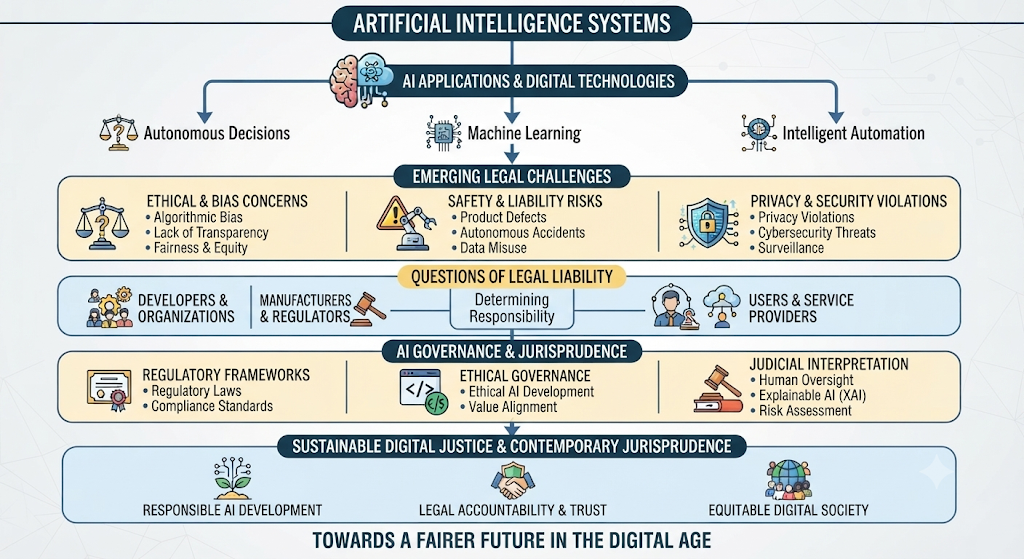
Figure: Conceptual Background
The growing integration of Artificial Intelligence into critical sectors has intensified debates regarding legal liability because intelligent systems frequently operate across national boundaries, process enormous volumes of personal data, and make decisions affecting fundamental human rights. Autonomous vehicles, medical diagnostic systems, financial algorithms, facial recognition technologies, generative AI applications, and intelligent robotic systems present situations where determining causation, fault, negligence, foreseeability, and accountability becomes significantly more complicated than under conventional legal frameworks. Existing doctrines of tort law, contract law, product liability, consumer protection, criminal law, intellectual property, and administrative law often struggle to accommodate autonomous decision-making systems that continuously evolve through machine learning. Furthermore, issues such as algorithmic bias, lack of transparency, explainability, cybersecurity vulnerabilities, data protection, digital surveillance, misinformation, and cross-border AI deployment have expanded the scope of legal challenges facing modern judicial systems. Governments, international organizations, courts, legal practitioners, technology companies, and academic institutions are increasingly recognizing the need for adaptive regulatory frameworks capable of balancing technological innovation with legal certainty, ethical responsibility, public safety, and protection of fundamental rights. Emerging concepts such as explainable Artificial Intelligence, human-centred AI, algorithmic auditing, regulatory sandboxes, AI impact assessments, and risk-based governance models are gaining importance in developing legally accountable AI ecosystems. International cooperation has also become essential because AI technologies frequently operate globally, requiring harmonized legal standards that facilitate innovation while ensuring consistent protection of privacy, fairness, transparency, and justice across jurisdictions. Understanding the evolving relationship between Artificial Intelligence and legal liability is therefore essential for shaping future jurisprudence capable of addressing the legal complexities introduced by autonomous technologies. Such understanding will support policymakers, judges, legal professionals, researchers, and technology developers in designing effective governance mechanisms that encourage innovation while maintaining accountability, protecting individual rights, and preserving public confidence in rapidly evolving digital societies.
Legal Liability Challenges Arising from Artificial Intelligence Systems#
Artificial Intelligence (AI) has fundamentally altered the traditional understanding of legal liability by introducing autonomous systems capable of making decisions, learning from experience, and adapting their behaviour with minimal or no direct human intervention. Conventional legal liability is generally based on the principles of causation, fault, negligence, intent, foreseeability, and accountability, where responsibility for harm can usually be attributed to identifiable human actors or organizations. However, AI systems challenge these principles because their decisions often result from complex machine learning algorithms that continuously evolve through exposure to new data, making it difficult to identify a single responsible party when harm occurs. One of the most significant legal challenges involves determining liability for autonomous decision-making. For example, autonomous vehicles may cause road accidents due to software errors, sensor failures, unexpected environmental conditions, or algorithmic miscalculations. In such situations, courts must determine whether legal responsibility should rest with the vehicle manufacturer, software developer, hardware supplier, owner, operator, maintenance provider, or another party involved in the AI ecosystem. Similar liability concerns arise in healthcare, where AI-assisted diagnostic systems or robotic surgical technologies may produce inaccurate recommendations leading to patient injury. Determining whether liability belongs to medical professionals, hospitals, software developers, or AI manufacturers presents complex jurisprudential questions that existing medical negligence laws may not adequately address. Product liability also becomes increasingly complicated because AI-based products continue learning and modifying their behaviour after entering the market. Traditional product liability laws assume that defects exist at the time of manufacture, whereas AI systems may develop unforeseen behaviours through continuous machine learning and software updates. Consequently, manufacturers may argue that post-deployment system behaviour falls outside their original responsibility, creating uncertainty regarding legal accountability. Another significant challenge concerns algorithmic bias and discriminatory decision-making. AI systems trained on biased or incomplete datasets may produce unfair outcomes affecting employment, education, financial services, healthcare, housing, insurance, and criminal justice. Discriminatory AI decisions may violate constitutional protections, human rights, consumer protection laws, and anti-discrimination legislation, raising difficult legal questions regarding organizational liability, developer responsibility, and regulatory oversight. Explainability presents another important legal issue because many advanced AI models function as "black-box" systems whose decision-making processes cannot easily be understood or interpreted. Courts frequently rely on evidence demonstrating why particular decisions were made, yet opaque AI algorithms often make it difficult to establish causation, negligence, or intent. This lack of transparency complicates judicial proceedings, limits procedural fairness, and may prevent affected individuals from effectively challenging automated decisions. Privacy and data protection represent additional areas of legal liability because AI systems process enormous quantities of personal and sensitive information obtained from healthcare records, financial transactions, online platforms, biometric systems, surveillance technologies, and social media. Unauthorized access, data breaches, identity theft, misuse of personal information, or violations of data protection regulations may expose organizations to substantial civil liability, regulatory penalties, and reputational damage. Cybersecurity failures further increase legal risks when inadequate security measures allow malicious actors to manipulate AI systems or exploit system vulnerabilities. Intellectual property law also faces new challenges as generative AI systems create text, images, music, software, and other creative works, raising questions regarding copyright ownership, originality, authorship, licensing, and infringement. Criminal liability represents another evolving area because AI technologies may facilitate cybercrime, deepfake creation, financial fraud, misinformation campaigns, and automated criminal activities, requiring courts to determine appropriate legal responsibility when autonomous technologies contribute to unlawful conduct. Cross-border AI operations further complicate liability because AI services frequently operate across multiple jurisdictions with differing legal standards, regulatory requirements, and enforcement mechanisms. Governments, courts, legal scholars, and international organizations therefore recognize the need to modernize existing legal doctrines through AI-specific legislation, adaptive regulatory frameworks, risk-based governance models, mandatory algorithmic audits, explainability requirements, human oversight mechanisms, and international legal cooperation. Ultimately, addressing legal liability challenges associated with Artificial Intelligence requires balancing technological innovation with justice, accountability, public safety, and the protection of fundamental rights, ensuring that AI systems remain legally responsible, ethically governed, and socially beneficial within rapidly evolving digital societies.
Emerging Jurisprudential Issues in AI Governance and Accountability#
The rapid evolution of Artificial Intelligence (AI) has introduced a wide range of jurisprudential issues that challenge traditional legal principles and require the development of modern governance frameworks capable of regulating intelligent technologies. Contemporary jurisprudence has historically been based on the assumption that legal rights, obligations, and liabilities arise from human conduct. However, AI systems increasingly perform autonomous decision-making, predictive analysis, and adaptive learning without continuous human supervision, creating uncertainty regarding legal accountability and judicial interpretation. One of the most significant jurisprudential challenges concerns determining the appropriate allocation of responsibility among AI developers, software engineers, manufacturers, technology companies, service providers, system operators, users, and regulatory authorities. Since AI systems often involve multiple stakeholders contributing to system design, training data, software updates, deployment, and operational management, identifying a single legally responsible party becomes highly complex when harm occurs. Courts must therefore reconsider traditional concepts of causation, negligence, foreseeability, and fault to address situations where autonomous algorithms produce unexpected outcomes that cannot be directly attributed to deliberate human actions. Another important issue involves algorithmic transparency and explainability. Many advanced machine learning models function as highly complex "black-box" systems whose internal reasoning cannot be easily understood by judges, lawyers, regulators, or affected individuals. The absence of explainability creates procedural difficulties because judicial systems require evidence, logical reasoning, and transparent decision-making to ensure fairness and due process. Explainable Artificial Intelligence (XAI) has therefore become increasingly important as a legal requirement for enabling courts to evaluate AI-generated decisions, assess accountability, and provide effective legal remedies. Algorithmic bias and discrimination also present major jurisprudential concerns because AI systems trained on biased datasets may produce unequal outcomes affecting employment, healthcare, education, housing, insurance, credit approvals, and criminal justice. Such discriminatory decisions may violate constitutional rights, equality principles, anti-discrimination laws, and international human rights standards, requiring courts to determine appropriate legal remedies and organizational responsibilities. Data protection and privacy represent another critical area of AI jurisprudence. Intelligent systems routinely process vast quantities of personal information, including biometric data, financial records, health information, behavioural patterns, and online activities. Questions regarding informed consent, lawful data processing, ownership of personal information, cross-border data transfers, and digital surveillance have become central legal issues requiring stronger regulatory oversight. Cybersecurity vulnerabilities further complicate legal accountability because unauthorized access, hacking, ransomware attacks, and AI system manipulation may cause significant financial, personal, and societal harm. Intellectual property law has also entered a new phase of development due to generative AI technologies capable of producing text, images, music, software code, and artistic content. Courts increasingly face disputes concerning copyright ownership, originality, patent eligibility, licensing rights, and the legal status of AI-generated works, challenging traditional concepts of authorship that have historically required human creativity. Emerging jurisprudence must also address legal questions involving autonomous vehicles, intelligent robots, medical AI systems, financial algorithms, military applications, and AI-assisted judicial decision-making. These technologies require clear legal standards regarding safety, human oversight, risk management, ethical responsibility, and liability allocation before widespread deployment. Governments worldwide are responding by developing AI-specific legislation, ethical guidelines, regulatory sandboxes, and risk-based governance models that balance innovation with public protection. International organizations have also proposed principles emphasizing transparency, accountability, fairness, human rights, privacy protection, and responsible AI governance to encourage harmonized legal standards across jurisdictions. Interdisciplinary collaboration among legal scholars, computer scientists, policymakers, ethicists, judges, and industry experts has become essential for developing adaptive jurisprudential frameworks capable of responding to rapidly evolving technologies. Ultimately, contemporary jurisprudence must evolve from traditional technology regulation toward dynamic legal systems that recognize the unique characteristics of Artificial Intelligence while preserving justice, legal certainty, democratic values, and the rule of law. Such adaptive legal frameworks will ensure that AI innovation progresses responsibly, protects individual rights, promotes public trust, and contributes to sustainable technological development in increasingly digital societies.
Regulatory Frameworks and Future Directions for AI Liability and Responsible Innovation#
The rapid advancement of Artificial Intelligence (AI) has created an urgent need for comprehensive regulatory frameworks that effectively address legal liability while encouraging responsible innovation and technological progress. Traditional legal systems, although effective for regulating conventional technologies, are often inadequate for addressing the complexities introduced by autonomous decision-making, adaptive machine learning, generative AI, and cross-border digital services. Consequently, governments, international organizations, regulatory authorities, and legal scholars are increasingly developing AI-specific governance models that balance innovation with accountability, public safety, ethical responsibility, and the protection of fundamental rights. One of the most important regulatory approaches is the adoption of risk-based AI governance, whereby AI applications are classified according to the level of risk they pose to individuals and society. High-risk AI systems used in healthcare, criminal justice, law enforcement, financial services, employment, education, and public administration require stricter legal oversight, mandatory compliance assessments, transparency obligations, and continuous monitoring than low-risk consumer applications. Such classification enables regulators to allocate legal responsibilities proportionately while promoting innovation in lower-risk sectors. Explainable Artificial Intelligence (XAI) should also become a mandatory regulatory requirement for high-impact AI systems. Transparent algorithms enable courts, regulators, organizations, and affected individuals to understand how AI-generated decisions are made, thereby improving accountability, procedural fairness, and legal certainty.
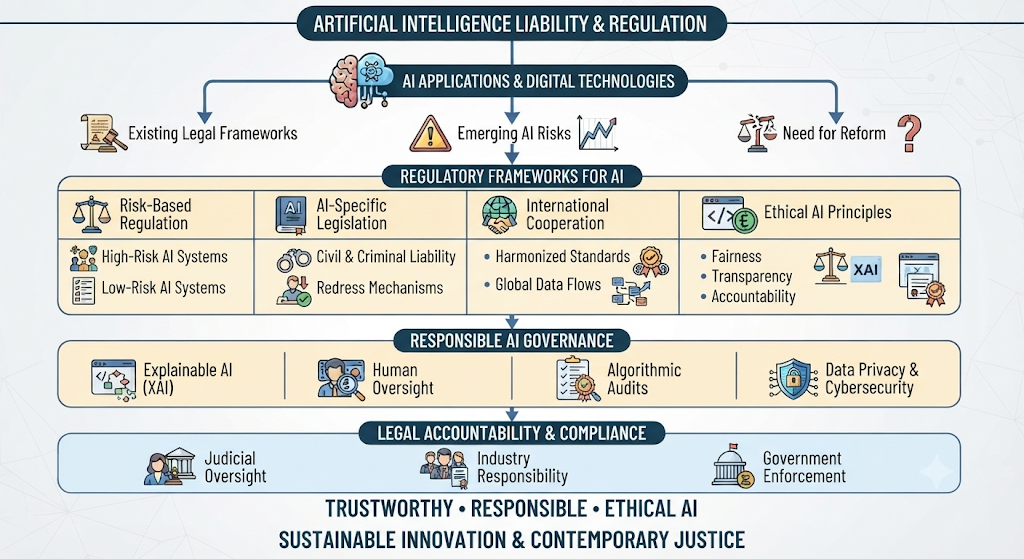
Figure : Regulatory Frameworks and Future Directions for AI Liability and Responsible Innovation
Human oversight remains another essential component of future AI regulation. Although intelligent systems can significantly enhance decision-making efficiency, final decisions affecting human rights, personal liberty, healthcare, financial security, or legal status should remain subject to meaningful human review. Human-in-the-loop governance reduces the risk of unjust automated decisions and ensures that legal responsibility remains identifiable. Regulatory frameworks should further require organizations to conduct AI impact assessments before deploying intelligent systems. These assessments should evaluate potential risks related to discrimination, privacy, cybersecurity, safety, environmental sustainability, human rights, and social consequences while identifying appropriate mitigation measures. Regular algorithmic audits performed by independent experts can further detect bias, security vulnerabilities, performance failures, and legal non-compliance throughout the AI lifecycle. Data governance also represents a fundamental pillar of responsible AI regulation. Organizations should implement privacy-by-design principles, secure data management practices, encryption, anonymization, access controls, and robust cybersecurity measures to protect sensitive personal information from unauthorized access or misuse. Compliance with national and international data protection laws should remain mandatory for organizations processing personal data through AI systems. International cooperation is increasingly necessary because AI applications frequently operate across multiple jurisdictions, making fragmented national regulations insufficient. Harmonized international standards addressing AI ethics, legal liability, cross-border data flows, intellectual property, cybersecurity, and digital governance can facilitate responsible global innovation while ensuring consistent protection of individual rights. Educational institutions should contribute by integrating AI law, technology ethics, digital governance, and cybersecurity into legal and professional education, preparing future lawyers, judges, policymakers, engineers, and regulators to manage emerging legal challenges effectively. Continuous judicial training is equally important because courts must understand rapidly evolving AI technologies when interpreting complex legal disputes involving autonomous systems. Technology companies should establish internal AI ethics committees, legal compliance teams, and multidisciplinary governance structures responsible for monitoring legal risks throughout product development and deployment. Collaboration among governments, academia, industry, civil society organizations, and international institutions will further strengthen evidence-based policymaking and adaptive regulatory development. Future legal reforms may also explore innovative concepts such as mandatory AI insurance schemes, specialized compensation mechanisms, regulatory sandboxes, and standardized contractual obligations for AI service providers to improve legal certainty while encouraging technological advancement. Ultimately, effective regulatory frameworks must balance innovation with accountability by ensuring that Artificial Intelligence remains transparent, explainable, secure, fair, and legally responsible. Such balanced governance will strengthen public confidence, protect individual rights, promote responsible innovation, and enable AI technologies to contribute positively to economic growth, social welfare, and the continued evolution of contemporary jurisprudence.
Conclusion#
Artificial Intelligence has fundamentally transformed the legal landscape by introducing autonomous technologies that challenge traditional concepts of legal liability, responsibility, negligence, accountability, and judicial interpretation. As intelligent systems increasingly participate in healthcare, transportation, finance, education, manufacturing, governance, commerce, and public administration, legal systems must adapt to address the unique characteristics of AI-driven decision-making. The present study demonstrates that conventional legal doctrines, originally designed to regulate human conduct and predictable technological systems, are often insufficient for resolving disputes involving adaptive algorithms, machine learning models, autonomous vehicles, intelligent robots, and generative AI applications. Determining liability becomes considerably more complex when multiple stakeholders—including developers, manufacturers, software providers, organizations, operators, users, and regulators—contribute to the functioning of AI systems. Furthermore, issues such as algorithmic bias, lack of explainability, privacy violations, cybersecurity risks, intellectual property disputes, data protection, and cross-border AI operations require modern jurisprudence to evolve beyond traditional legal principles. The study highlights the importance of explainable Artificial Intelligence, human oversight, algorithmic transparency, ethical governance, and risk-based regulatory approaches in strengthening legal accountability and public confidence. Governments have a crucial responsibility to establish comprehensive legislative frameworks that clearly define legal obligations, regulatory standards, liability allocation, and enforcement mechanisms while encouraging innovation and protecting fundamental rights. Technology companies must integrate legal compliance, ethical principles, privacy protection, cybersecurity, and fairness into every stage of AI system design, development, deployment, and maintenance. Independent audits, AI impact assessments, regulatory oversight, and multidisciplinary ethics committees can further improve accountability and reduce legal uncertainty. Educational institutions also play a significant role by preparing future legal professionals, policymakers, engineers, and researchers with interdisciplinary knowledge combining law, technology, ethics, cybersecurity, and public policy. International cooperation has become increasingly essential because AI technologies operate globally, requiring harmonized legal standards capable of addressing transnational liability, digital governance, and cross-border enforcement challenges. Collaboration among governments, international organizations, legal scholars, judiciary, industry leaders, and civil society will facilitate the development of adaptive legal frameworks that remain responsive to future technological innovations. The study concludes that the future of legal liability in the age of Artificial Intelligence depends on achieving a careful balance between technological advancement and the protection of justice, human dignity, transparency, accountability, and the rule of law. Rather than restricting innovation, effective legal governance should promote responsible technological development while ensuring that individuals harmed by AI systems have access to appropriate legal remedies and judicial protection. As Artificial Intelligence continues to evolve, contemporary jurisprudence must likewise embrace continuous legal reform, interdisciplinary collaboration, and evidence-based policymaking to create resilient legal systems capable of addressing emerging technological challenges while fostering public trust, sustainable innovation, and equitable digital societies.
Works Cited#
- European Commission. (2024). *Artificial Intelligence Act*. Brussels: European Union.
- United Nations Educational, Scientific and Cultural Organization. (2021). *Recommendation on the Ethics of Artificial Intelligence*. Paris: UNESCO.
- Organisation for Economic Co-operation and Development. (2019). *OECD Principles on Artificial Intelligence*. Paris: OECD Publishing.
- National Institute of Standards and Technology. (2023). *Artificial Intelligence Risk Management Framework (AI RMF 1.0)*. Gaithersburg, MD.
- World Economic Forum. (2024). *The Future of Trustworthy Artificial Intelligence*. Geneva: World Economic Forum.
- Council of Europe. (2024). *Framework Convention on Artificial Intelligence, Human Rights, Democracy and the Rule of Law*.
- Russell, Stuart., & Norvig, Peter. (2021). *Artificial Intelligence: A Modern Approach* (4th ed.). Pearson.
- Floridi, Luciano., & Cowls, Josh. (2019). A unified framework of five principles for AI in society. *Harvard Data Science Review*.
- Mittelstadt, Brent D.., et al. (2016). The ethics of algorithms. *Big Data & Society, 3*(2).
- Jobin, Anna., Ienca, Marcello., & Vayena, Effy. (2019). The global landscape of AI ethics guidelines. *Nature Machine Intelligence, 1*(9), 389–399.
- Ribeiro, Marco Tulio., Singh, Sameer., & Guestrin, Carlos. (2016). "Why Should I Trust You?" Explaining the Predictions of Any Classifier. *Proceedings of the ACM SIGKDD Conference*.
- Barocas, Solon., & Selbst, Andrew D.. (2016). Big data's disparate impact. *California Law Review, 104*(3), 671–732.
- Dwork, Cynthia., et al. (2012). Fairness through awareness. *Proceedings of the 3rd Innovations in Theoretical Computer Science Conference*.
- Surden, Harry. (2019). Artificial intelligence and law: An overview. *Georgia State University Law Review, 35*(4), 1305–1334.
- Calo, Ryan. (2015). Robotics and the lessons of cyberlaw. *California Law Review, 103*(3), 513–563.
- Pagallo, Ugo. (2013). *The Laws of Robots: Crimes, Contracts, and Torts*. Springer.
- Bertolini, Andrea. (2020). Artificial Intelligence and Civil Liability. *European Parliament Study*.
- World Health Organization. (2021). *Ethics and Governance of Artificial Intelligence for Health*. Geneva: WHO.
- Stanford Institute for Human-Centered Artificial Intelligence. (2024). *AI Index Report 2024*. Stanford University.
- Association for Computing Machinery. (2018). *ACM Code of Ethics and Professional Conduct*.