Abstract
Environmental, Social, and Governance (ESG) compliance has emerged as a critical framework guiding corporate governance, sustainable development, and responsible investment across the globe. Increasing concerns regarding climate change, environmental degradation, human rights violations, labor standards, and corporate accountability have encouraged governments and regulatory authorities to introduce mandatory ESG disclosure requirements and sustainability reporting frameworks. ESG compliance extends beyond voluntary corporate social responsibility initiatives by integrating legal obligations, ethical business practices, and risk management strategies into organizational decision-making. International initiatives such as the United Nations Sustainable Development Goals (SDGs), Paris Climate Agreement, Global Reporting Initiative (GRI), and International Sustainability Standards Board (ISSB) have significantly influenced national legal systems and corporate governance standards. In India, regulatory institutions including the Securities and Exchange Board of India (SEBI), Ministry of Corporate Affairs (MCA), and environmental legislations have strengthened ESG-related reporting through the Business Responsibility and Sustainability Report (BRSR). Emerging legal perspectives focus on climate litigation, mandatory due diligence, green finance regulations, carbon disclosure obligations, stakeholder rights, diversity and inclusion, and board accountability. Simultaneously, organizations face challenges such as regulatory fragmentation, greenwashing, inconsistent reporting standards, and enforcement limitations. This study explores the evolving legal framework governing ESG compliance, analyzes emerging global and Indian legal developments, identifies implementation challenges, and discusses future opportunities for harmonized sustainability governance. Effective ESG compliance not only enhances corporate transparency and investor confidence but also contributes significantly to sustainable economic growth, environmental protection, social justice, and long-term corporate resilience.
- Environmental Governance
- Social Responsibility
- Corporate Governance
- ESG Compliance
- Sustainability Reporting
- Climate Law
- Green Finance
- Corporate Accountability
- Legal Framework
- Sustainable Development
Introduction#
Environmental, Social, and Governance (ESG) compliance has become one of the most influential concepts shaping corporate law, business ethics, investment decisions, and regulatory governance in the twenty-first century. Traditionally, business organizations were evaluated primarily based on profitability and shareholder value. However, globalization, climate change, environmental degradation, increasing social inequalities, corporate scandals, and stakeholder activism have transformed expectations regarding corporate behavior. Governments, investors, consumers, employees, and civil society now demand that corporations operate responsibly while balancing economic growth with environmental sustainability and social welfare.
The Environmental pillar focuses on how organizations manage natural resources, reduce greenhouse gas emissions, conserve biodiversity, control pollution, improve energy efficiency, and comply with environmental regulations. Climate-related disclosures, carbon neutrality targets, waste management, renewable energy adoption, and sustainable supply chains have become essential components of environmental compliance.The Social component addresses human rights, labor welfare, workplace diversity, occupational safety, employee well-being, gender equality, consumer protection, community engagement, and ethical sourcing practices. Organizations are increasingly expected to protect workers' rights throughout global supply chains while promoting inclusive growth and social justice.
The Governance dimension examines corporate leadership, board independence, executive accountability, anti-corruption measures, cybersecurity governance, risk management, shareholder rights, transparency, and ethical decision-making. Effective governance ensures that organizations maintain integrity, legal compliance, and stakeholder trust.
ESG compliance has evolved from voluntary sustainability initiatives into mandatory legal obligations in many jurisdictions. International organizations including the United Nations (UN), Organisation for Economic Co-operation and Development (OECD), International Labour Organization (ILO), European Union (EU), and International Sustainability Standards Board (ISSB) have developed comprehensive frameworks encouraging responsible corporate conduct.
India has also made significant progress in institutionalizing ESG governance. The Securities and Exchange Board of India (SEBI) introduced the Business Responsibility and Sustainability Report (BRSR) framework, replacing earlier Business Responsibility Reports. The Companies Act, 2013, Environmental Protection Act, 1986, Corporate Social Responsibility (CSR) provisions, and various labor and environmental regulations collectively contribute to India's ESG compliance ecosystem.
Simultaneously, ESG has become an important consideration for financial institutions and investors. Sustainable finance, green bonds, ESG-based mutual funds, responsible investment portfolios, and climate risk assessments increasingly influence investment decisions. Companies demonstrating strong ESG performance often benefit from improved investor confidence, lower financing costs, enhanced reputation, better operational resilience, and long-term competitiveness.
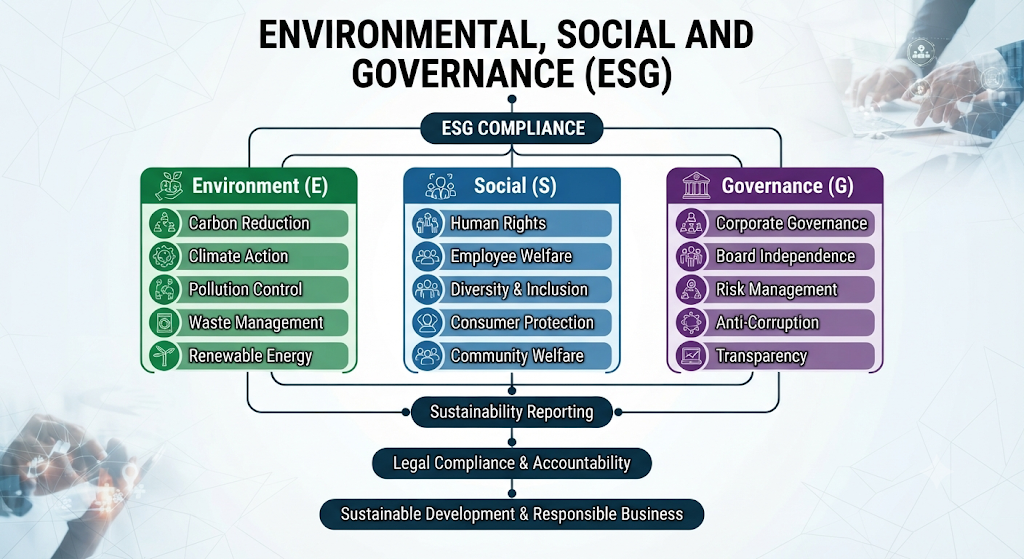
Figure: Conceptual Background
Despite rapid adoption, ESG compliance also faces several legal and practical challenges. Differences in reporting standards, inconsistent disclosure methodologies, greenwashing, inadequate enforcement mechanisms, jurisdictional variations, and increasing compliance costs create uncertainty for businesses. Moreover, emerging climate litigation, supply chain due diligence laws, biodiversity regulations, and human rights obligations continue to reshape ESG legal frameworks worldwide.
The future of ESG compliance lies in developing harmonized international reporting standards, stronger legal enforcement, digital sustainability reporting, AI-enabled compliance monitoring, transparent governance systems, and stakeholder-centric corporate accountability. As sustainability becomes central to global economic development, ESG compliance represents not merely a regulatory requirement but a strategic legal framework promoting responsible business conduct, environmental conservation, social equity, and long-term economic resilience.
Evolution of ESG Compliance and Emerging Global Legal Frameworks#
Environmental, Social, and Governance (ESG) compliance has undergone a remarkable transformation over the past three decades, evolving from a voluntary corporate responsibility initiative into a legally significant framework influencing business regulation, investment practices, and public policy worldwide. Initially, environmental conservation and corporate social responsibility (CSR) were treated as ethical obligations rather than enforceable legal requirements. Businesses primarily focused on maximizing shareholder wealth, with limited consideration for environmental protection or broader societal interests. However, growing awareness of climate change, biodiversity loss, industrial pollution, labor exploitation, corporate fraud, and governance failures fundamentally altered this perspective. Governments, international organizations, financial institutions, and civil society increasingly recognized that sustainable economic development requires legally enforceable standards governing corporate conduct.
One of the earliest milestones in ESG evolution was the concept of sustainable development introduced through the Brundtland Report (1987), which emphasized meeting present needs without compromising the ability of future generations to meet their own. This principle later became central to international environmental law and corporate sustainability policies. The 1992 Rio Earth Summit further strengthened global commitments by encouraging businesses to integrate environmental considerations into their operational strategies. Subsequently, the United Nations Global Compact invited corporations to voluntarily adopt principles related to human rights, labor standards, environmental responsibility, and anti-corruption. Although initially non-binding, these initiatives established the foundation for modern ESG governance.
The adoption of the United Nations Sustainable Development Goals (SDGs) in 2015 significantly accelerated ESG integration by identifying seventeen global development objectives encompassing poverty reduction, climate action, gender equality, clean energy, responsible consumption, and institutional accountability. The same year, the Paris Climate Agreement created legally influential commitments for countries to reduce greenhouse gas emissions and transition toward low-carbon economies. These international agreements encouraged governments to introduce national legislation requiring climate-related disclosures, environmental reporting, and sustainability governance within corporate sectors.
Financial regulators also played a transformative role in ESG development. Investors increasingly demanded standardized information regarding climate risks, labor practices, executive governance, and corporate sustainability performance. Consequently, organizations such as the Global Reporting Initiative (GRI), Sustainability Accounting Standards Board (SASB), Task Force on Climate-related Financial Disclosures (TCFD), and more recently the International Sustainability Standards Board (ISSB) developed comprehensive reporting standards that enable investors to evaluate ESG risks consistently. Many jurisdictions now require listed companies to disclose sustainability information using these internationally recognized frameworks.
The European Union has emerged as a global leader in ESG regulation through legally binding instruments such as the Corporate Sustainability Reporting Directive (CSRD), Sustainable Finance Disclosure Regulation (SFDR), and Corporate Sustainability Due Diligence Directive (CSDDD). These laws require companies to assess environmental and human rights impacts throughout their operations and supply chains, while imposing legal responsibilities on corporate directors regarding sustainability governance. Mandatory due diligence obligations represent a significant shift from voluntary compliance toward enforceable legal accountability.
Similarly, several countries including the United Kingdom, Canada, Australia, Japan, Singapore, and South Africa have introduced climate disclosure regulations, green finance policies, and governance reforms that integrate ESG principles into financial markets. Stock exchanges increasingly require sustainability reporting as a listing obligation, reflecting investor expectations regarding long-term corporate resilience and responsible governance.
Emerging legal perspectives also focus on climate litigation, where governments, corporations, and financial institutions face lawsuits alleging insufficient action to address climate change or misleading environmental claims. Courts in multiple jurisdictions have increasingly recognized that corporations owe legal duties to manage environmental risks responsibly. Climate-related litigation has therefore become a powerful mechanism encouraging stronger ESG compliance.
Another significant legal development involves mandatory human rights due diligence. Businesses operating global supply chains are now expected to identify, prevent, mitigate, and remedy adverse human rights impacts associated with suppliers, contractors, and subsidiaries. This approach expands corporate accountability beyond direct operations to encompass broader value chains, promoting ethical sourcing and responsible business conduct.
Despite substantial progress, ESG regulation remains fragmented internationally. Different jurisdictions apply varying reporting standards, disclosure requirements, enforcement mechanisms, and legal definitions, creating compliance challenges for multinational corporations. Nevertheless, international convergence efforts led by ISSB and other standard-setting organizations seek to establish harmonized sustainability reporting standards that improve comparability and transparency across global markets.
Overall, ESG compliance has evolved into a multidimensional legal framework that integrates environmental protection, social responsibility, and sound corporate governance into business regulation. Emerging legal developments indicate that ESG will continue shifting from voluntary best practices toward comprehensive legal obligations supported by stronger regulatory oversight, investor scrutiny, judicial enforcement, and international cooperation.
Indian Legal Framework for ESG Compliance and Corporate Sustainability Governance#
India has emerged as one of the leading economies integrating Environmental, Social, and Governance (ESG) principles into its corporate regulatory framework, recognizing that sustainable development, responsible business conduct, and long-term economic growth are interconnected. Although ESG compliance in India was initially driven by voluntary corporate social responsibility initiatives and international investor expectations, recent legislative and regulatory developments have transformed it into an increasingly structured legal and governance framework. The Indian Constitution itself provides a strong foundation for environmental protection and social justice through Articles 21, 48A, and 51A(g), which collectively emphasize the right to life, environmental conservation, and the fundamental duty of citizens to protect natural resources. Building upon these constitutional principles, several statutory enactments such as the Environmental (Protection) Act, 1986, the Water (Prevention and Control of Pollution) Act, 1974, the Air (Prevention and Control of Pollution) Act, 1981, the Biological Diversity Act, 2002, the Forest (Conservation) Act, 1980, and the Energy Conservation Act, 2001 establish legal obligations for industries to minimize pollution, conserve biodiversity, efficiently utilize natural resources, and adopt environmentally sustainable practices. These laws are enforced through regulatory agencies such as the Central Pollution Control Board (CPCB), State Pollution Control Boards (SPCBs), the Ministry of Environment, Forest and Climate Change (MoEFCC), and the National Green Tribunal (NGT), which play a significant role in ensuring environmental accountability. The governance aspect of ESG has been substantially strengthened by the Companies Act, 2013, which introduced comprehensive corporate governance standards relating to board composition, independent directors, audit committees, risk management, stakeholder protection, ethical business practices, internal financial controls, and mandatory Corporate Social Responsibility (CSR) spending under Section 135. India became one of the first countries to legally mandate CSR expenditure for eligible companies, thereby institutionalizing the social dimension of ESG through investments in education, healthcare, sanitation, environmental sustainability, rural development, gender equality, skill development, and poverty alleviation. The Securities and Exchange Board of India (SEBI) has further accelerated ESG integration by introducing the Business Responsibility and Sustainability Report (BRSR), replacing the earlier Business Responsibility Report (BRR). Initially applicable to the top 1,000 listed companies by market capitalization, the BRSR requires detailed disclosures regarding greenhouse gas emissions, energy consumption, water usage, waste management, biodiversity conservation, employee welfare, occupational health and safety, gender diversity, human rights protection, consumer welfare, supply chain sustainability, governance practices, board oversight, ethical conduct, anti-corruption measures, and stakeholder engagement. This reporting framework aligns Indian corporate disclosures with internationally recognized standards such as the Global Reporting Initiative (GRI), the International Sustainability Standards Board (ISSB), the Task Force on Climate-related Financial Disclosures (TCFD), and the United Nations Sustainable Development Goals (SDGs), thereby improving transparency, comparability, and investor confidence. ESG considerations have also become increasingly important within India's financial sector. The Reserve Bank of India (RBI), SEBI, insurance regulators, stock exchanges, mutual funds, and banking institutions have promoted sustainable finance through green bonds, ESG-focused investment funds, climate risk assessment, sustainable lending practices, and responsible investment guidelines. Institutional investors increasingly evaluate corporate ESG performance before making investment decisions, encouraging companies to strengthen sustainability governance and long-term risk management. Judicial institutions have also contributed significantly to ESG evolution through landmark environmental judgments emphasizing sustainable development, the precautionary principle, the polluter pays principle, intergenerational equity, and the public trust doctrine. The Supreme Court of India and the National Green Tribunal have consistently expanded environmental jurisprudence by holding industries accountable for ecological damage, pollution, and non-compliance with statutory environmental obligations. Simultaneously, labor reforms through the Occupational Safety, Health and Working Conditions Code, Code on Social Security, Code on Wages, and Industrial Relations Code seek to strengthen employee welfare, workplace safety, fair remuneration, and social protection, reinforcing the social component of ESG. Despite these advances, Indian companies continue to encounter significant implementation challenges, including inconsistent ESG metrics, limited availability of reliable sustainability data, varying reporting methodologies, high compliance costs for small and medium enterprises, shortage of ESG professionals, fragmented regulatory requirements, and concerns regarding greenwashing. Many organizations continue to treat ESG primarily as a reporting obligation rather than integrating sustainability into core business strategy, governance, and operational decision-making. Moreover, evolving global standards require Indian corporations to continuously upgrade disclosure systems, supply chain monitoring, carbon accounting mechanisms, and climate risk management practices to remain internationally competitive. Looking ahead, India's ESG legal framework is expected to evolve further through mandatory climate-related financial disclosures, stronger supply chain due diligence requirements, carbon market regulations, digital sustainability reporting, artificial intelligence-based ESG monitoring systems, biodiversity conservation policies, circular economy legislation, and enhanced enforcement mechanisms. As India advances toward achieving its commitments under the Paris Climate Agreement, Net Zero targets, and the Sustainable Development Goals, ESG compliance will increasingly become a strategic legal imperative that promotes responsible corporate governance, sustainable investment, environmental stewardship, stakeholder trust, and inclusive economic development while strengthening India's position in the global sustainable business ecosystem.
Emerging Legal Challenges, Greenwashing, Climate Litigation, and Future Perspectives of ESG Compliance#
Environmental, Social, and Governance (ESG) compliance has rapidly evolved into a cornerstone of corporate regulation; however, its implementation presents several emerging legal challenges that require robust regulatory responses and international cooperation. One of the foremost challenges is the absence of universally harmonized ESG reporting standards. Although frameworks such as the Global Reporting Initiative (GRI), International Sustainability Standards Board (ISSB), Sustainability Accounting Standards Board (SASB), Task Force on Climate-related Financial Disclosures (TCFD), and regional regulations provide guidance, differences in reporting methodologies, materiality assessments, disclosure requirements, and performance indicators create inconsistencies across jurisdictions. Multinational corporations operating in multiple countries often struggle to comply with varying legal obligations, resulting in increased compliance costs and legal uncertainty. Another significant concern is greenwashing, whereby companies exaggerate or falsely represent their environmental or social performance to enhance their public image or attract investors. Misleading sustainability claims, inaccurate carbon neutrality declarations, unsupported net-zero commitments, and deceptive environmental marketing have prompted regulators worldwide to strengthen consumer protection laws, securities regulations, and corporate disclosure requirements. Greenwashing not only misleads investors and consumers but also undermines public confidence in genuine sustainability initiatives, leading to increased legal scrutiny, enforcement actions, financial penalties, and reputational damage. Climate litigation has also emerged as one of the most influential legal developments shaping ESG governance. Governments, corporations, financial institutions, and directors increasingly face lawsuits alleging inadequate climate action, failure to disclose climate-related financial risks, environmental negligence, biodiversity destruction, and violations of constitutional environmental rights. Courts in numerous jurisdictions have recognized that climate change presents serious legal, economic, and human rights implications, thereby expanding corporate duties regarding environmental risk management and sustainability disclosures. These judicial decisions reinforce principles such as sustainable development, intergenerational equity, the precautionary principle, and the polluter pays doctrine, encouraging businesses to integrate climate considerations into strategic decision-making. Supply chain governance presents another complex legal challenge within ESG compliance. Modern corporations often operate through global supply networks involving suppliers, contractors, and subsidiaries across multiple jurisdictions with differing labor standards, environmental regulations, and human rights protections. Emerging mandatory human rights and environmental due diligence laws require companies to identify, assess, prevent, mitigate, and remedy adverse impacts throughout their value chains. Failure to monitor supply chain practices may expose organizations to regulatory sanctions, contractual disputes, civil liability, and reputational risks arising from issues such as child labor, forced labor, unsafe working conditions, discrimination, deforestation, illegal mining, and environmental degradation.
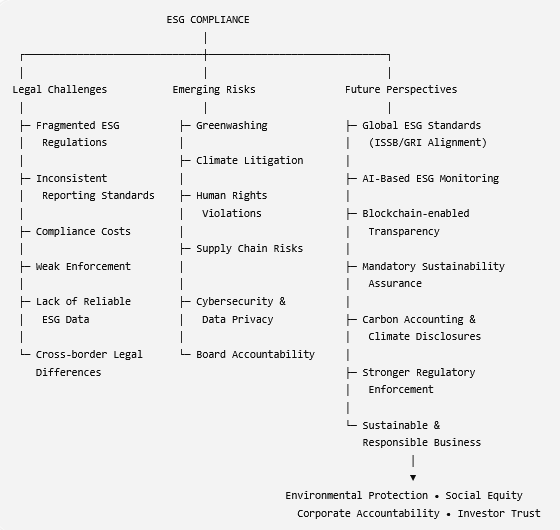
Figure: Emerging Legal Challenges and Future Perspectives of ESG Compliance
The governance component of ESG is equally challenged by cybersecurity threats, data privacy concerns, artificial intelligence governance, executive accountability, and board oversight responsibilities. Digital transformation has significantly increased organizational dependence on information systems, making cybersecurity governance an essential element of responsible corporate management. Boards of directors are now expected to oversee cyber risk management, data protection, ethical AI deployment, and digital resilience as part of their fiduciary responsibilities. Furthermore, diversity, equity, and inclusion (DEI) initiatives continue to gain legal significance as regulators encourage greater representation of women, minorities, and independent professionals on corporate boards and in senior management positions. Despite growing regulatory attention, organizations often face practical difficulties in measuring social performance indicators, maintaining reliable ESG data, and integrating sustainability objectives into corporate strategy. Small and medium-sized enterprises (SMEs) encounter additional financial and technical barriers due to limited resources, lack of specialized expertise, and increasing reporting obligations imposed by investors, lenders, and large multinational customers. Consequently, capacity building, digital reporting tools, standardized metrics, and government support mechanisms are becoming increasingly important for effective ESG implementation. Looking toward the future, ESG compliance is expected to become more technology-driven, legally enforceable, and globally harmonized. Artificial intelligence, blockchain technology, Internet of Things (IoT) devices, satellite monitoring, remote sensing, and advanced data analytics will improve the accuracy, transparency, and real-time monitoring of sustainability performance while reducing reporting errors and opportunities for fraud. Carbon markets, biodiversity credits, sustainable finance regulations, climate-related financial disclosures, circular economy legislation, and mandatory environmental due diligence are likely to become integral components of national legal systems. International cooperation among governments, regulatory authorities, financial institutions, and standard-setting organizations will play a vital role in establishing globally consistent ESG standards that facilitate cross-border investment and responsible business practices. Simultaneously, regulators are expected to strengthen enforcement mechanisms through higher financial penalties, independent sustainability assurance requirements, mandatory external audits, and enhanced corporate accountability for inaccurate ESG disclosures. Ultimately, the future of ESG compliance lies in integrating sustainability into the core governance structure of organizations rather than treating it merely as a reporting obligation. Effective legal frameworks, transparent governance systems, ethical corporate leadership, stakeholder participation, technological innovation, and international collaboration will collectively ensure that ESG compliance contributes to environmental protection, social equity, economic resilience, investor confidence, and sustainable development in an increasingly interconnected global economy.
Conclusion#
Environmental, Social, and Governance (ESG) compliance has evolved from a voluntary corporate responsibility initiative into a comprehensive legal and governance framework that shapes modern business practices, investment decisions, and public policy across the world. Growing concerns regarding climate change, environmental degradation, social inequality, human rights protection, labor welfare, ethical governance, and sustainable economic development have compelled governments, regulatory authorities, financial institutions, investors, and corporations to recognize ESG as an essential component of long-term organizational success. The environmental dimension encourages responsible resource utilization, pollution prevention, carbon emission reduction, biodiversity conservation, renewable energy adoption, and climate resilience. The social dimension promotes human rights, employee welfare, diversity and inclusion, occupational health and safety, consumer protection, community engagement, and ethical supply chain management. The governance pillar strengthens board accountability, transparency, anti-corruption measures, risk management, regulatory compliance, cybersecurity governance, and stakeholder confidence. Together, these three pillars establish a holistic approach that balances economic growth with environmental sustainability and social justice. International developments, including the United Nations Sustainable Development Goals (SDGs), the Paris Climate Agreement, Global Reporting Initiative (GRI), International Sustainability Standards Board (ISSB), and various sustainability disclosure frameworks, have significantly influenced national legal systems by encouraging greater transparency and accountability. India has also made substantial progress through constitutional environmental principles, environmental protection legislation, the Companies Act, 2013, Corporate Social Responsibility (CSR) provisions, Securities and Exchange Board of India (SEBI) Business Responsibility and Sustainability Reporting (BRSR) requirements, judicial activism, and sustainable finance initiatives, demonstrating its commitment to integrating ESG into corporate governance and economic development. Nevertheless, ESG implementation continues to face numerous legal and practical challenges, including fragmented reporting standards, inconsistent regulatory approaches, greenwashing, limited data reliability, high compliance costs, inadequate enforcement, supply chain complexities, and evolving technological risks. Climate litigation, mandatory human rights due diligence, digital governance, artificial intelligence regulation, and sustainable finance are rapidly expanding the legal scope of ESG compliance, requiring organizations to adopt proactive governance strategies and continuous legal adaptation. Businesses can no longer treat ESG merely as a reputational or marketing exercise; instead, sustainability considerations must become an integral part of corporate strategy, operational decision-making, enterprise risk management, and board oversight. Investors increasingly evaluate ESG performance when allocating capital, while consumers, employees, regulators, and civil society expect organizations to demonstrate measurable commitments toward sustainability and ethical governance. Future ESG governance will be characterized by greater international harmonization of reporting standards, mandatory sustainability assurance, AI-enabled compliance monitoring, blockchain-supported transparency, digital sustainability reporting, carbon accounting, biodiversity conservation policies, and stronger regulatory enforcement. Governments must continue developing coherent legal frameworks that encourage innovation while preventing regulatory fragmentation and compliance uncertainty. Simultaneously, corporations should invest in sustainability expertise, technological infrastructure, transparent reporting systems, employee awareness, and responsible leadership to strengthen ESG performance and resilience. Academic institutions, policymakers, legal professionals, and regulatory agencies also play an important role in promoting ESG education, research, capacity building, and legal reforms that support sustainable development. Ultimately, ESG compliance represents far more than a regulatory obligation; it reflects a transformative legal philosophy that aligns economic prosperity with environmental stewardship, social responsibility, and ethical governance. As sustainability becomes increasingly central to global development, effective ESG compliance will remain indispensable for protecting natural ecosystems, safeguarding stakeholder interests, enhancing corporate accountability, fostering investor confidence, supporting inclusive economic growth, and ensuring that future generations inherit a more resilient, equitable, and sustainable world.
Works Cited#
- Brundtland, G. H. (1987). Our Common Future. Oxford University Press.
- Eccles, R. G., Ioannou, I., & Serafeim, G. (2014). The impact of corporate sustainability on organizational processes and performance. Management Science, 60(11), 2835–2857.
- European Commission. (2022). Corporate Sustainability Reporting Directive (CSRD). Publications Office of the European Union.
- Freeman, R. E. (1984). Strategic Management: A Stakeholder Approach. Pitman Publishing.
- Global Reporting Initiative. (2023). GRI Universal Standards. Global Reporting Initiative.
- International Sustainability Standards Board. (2023). IFRS S1: General Requirements for Disclosure of Sustainability-related Financial Information. IFRS Foundation.
- International Sustainability Standards Board. (2023). IFRS S2: Climate-related Disclosures. IFRS Foundation.
- Ministry of Corporate Affairs. (2019). National Guidelines on Responsible Business Conduct. Government of India.
- Organisation for Economic Co-operation and Development. (2023). OECD Guidelines for Multinational Enterprises on Responsible Business Conduct. OECD Publishing.
- Paris Agreement. (2015). United Nations Framework Convention on Climate Change.
- Securities and Exchange Board of India. (2021). Business Responsibility and Sustainability Reporting by Listed Entities. SEBI Circular.
- Securities and Exchange Board of India. (2023). SEBI (Listing Obligations and Disclosure Requirements) Regulations. SEBI.
- United Nations. (2015). Transforming Our World: The 2030 Agenda for Sustainable Development. United Nations.
- United Nations Global Compact. (2023). The Ten Principles of the UN Global Compact. United Nations.
- World Bank. (2022). ESG Framework and Corporate Sustainability. World Bank Publications.
- Gillan, S. L., Koch, A., & Starks, L. T. (2021). Firms and social responsibility: A review of ESG and CSR research. Journal of Corporate Finance, 66, 101889.
- Friede, G., Busch, T., & Bassen, A. (2015). ESG and financial performance: Aggregated evidence from more than 2,000 empirical studies. Journal of Sustainable Finance & Investment, 5(4), 210–233.
- Kotsantonis, S., Pinney, C., & Serafeim, G. (2016). ESG integration in investment management. Journal of Applied Corporate Finance, 28(2), 10–16.
- Scholtens, B. (2008). A note on the interaction between corporate social responsibility and financial performance. Ecological Economics, 68(1–2), 46–55.
- United Nations Environment Programme Finance Initiative. (2023). Principles for Responsible Investment and Sustainable Finance. UNEP FI.