Abstract
Corruption remains one of the most persistent obstacles to sustainable development, democratic governance, economic growth, and social justice in developing countries. It undermines public trust, weakens state institutions, distorts public resource allocation, discourages domestic and foreign investment, and exacerbates poverty and inequality. Recognizing these adverse consequences, many developing countries have enacted comprehensive anti-corruption legislation and established governance mechanisms aimed at promoting transparency, accountability, integrity, and the rule of law. These measures include anti-corruption commissions, independent investigative agencies, public procurement reforms, asset declaration systems, whistleblower protection laws, digital governance initiatives, and international cooperation under multilateral legal frameworks. Despite these reforms, the effectiveness of anti-corruption regimes varies considerably due to differences in political commitment, institutional capacity, judicial independence, administrative efficiency, and socio-economic conditions. A comparative analysis of anti-corruption laws and governance mechanisms provides valuable insights into the strengths and weaknesses of diverse legal and institutional approaches adopted by developing countries. It enables policymakers to identify best practices, evaluate implementation challenges, and formulate strategies that enhance accountability while respecting constitutional principles and local governance contexts. International instruments such as the United Nations Convention against Corruption (UNCAC) have further encouraged legal harmonization by establishing global standards for criminalization, asset recovery, international cooperation, preventive measures, and public sector integrity. This chapter critically examines anti-corruption legislation and governance mechanisms in selected developing countries through a comparative legal perspective. It analyzes legislative frameworks, institutional structures, enforcement challenges, judicial oversight, and emerging trends in digital governance. The chapter concludes that effective anti-corruption strategies require strong political will, independent institutions, transparent governance, citizen participation, technological innovation, and sustained international collaboration to strengthen democratic governance and promote sustainable development.
- Corruption
- Anti-Corruption Laws
- Governance
- Transparency
- Accountability
- Rule of Law
- Developing Countries
- Public Administration
- Comparative Law
- UNCAC
Introduction#
Corruption has long been recognized as one of the most significant barriers to good governance, economic development, social justice, and democratic stability in developing countries. It encompasses the abuse of entrusted public or private power for personal gain and manifests in various forms, including bribery, embezzlement, fraud, nepotism, favoritism, money laundering, abuse of office, illicit enrichment, and procurement irregularities. The consequences of corruption extend beyond financial losses, affecting public service delivery, weakening institutional legitimacy, undermining investor confidence, increasing poverty, and eroding citizens' trust in government. As globalization has intensified economic interdependence and international financial transactions, corruption has increasingly assumed transnational dimensions, requiring coordinated legal and institutional responses at both national and international levels.
Developing countries often experience heightened vulnerability to corruption due to structural challenges such as weak institutional capacity, limited administrative resources, political instability, inadequate regulatory enforcement, low public sector accountability, and insufficient judicial independence. In response, governments have undertaken extensive legal reforms aimed at strengthening integrity within public administration, enhancing transparency, improving financial accountability, and reinforcing the rule of law. Many countries have enacted specialized anti-corruption legislation criminalizing corrupt practices while establishing independent anti-corruption commissions, ethics bodies, ombudsman institutions, financial intelligence units, public procurement authorities, and specialized investigative agencies responsible for preventing, detecting, and prosecuting corruption.
International legal instruments have significantly influenced these domestic reforms. The United Nations Convention against Corruption (UNCAC) provides the most comprehensive global legal framework for combating corruption through preventive measures, criminalization, international cooperation, asset recovery, technical assistance, and public sector integrity. Regional organizations have also developed anti-corruption conventions and governance standards encouraging member states to strengthen institutional accountability and harmonize national legal frameworks. Consequently, many developing countries have incorporated international anti-corruption principles into domestic legislation while adapting them to local constitutional and administrative contexts.
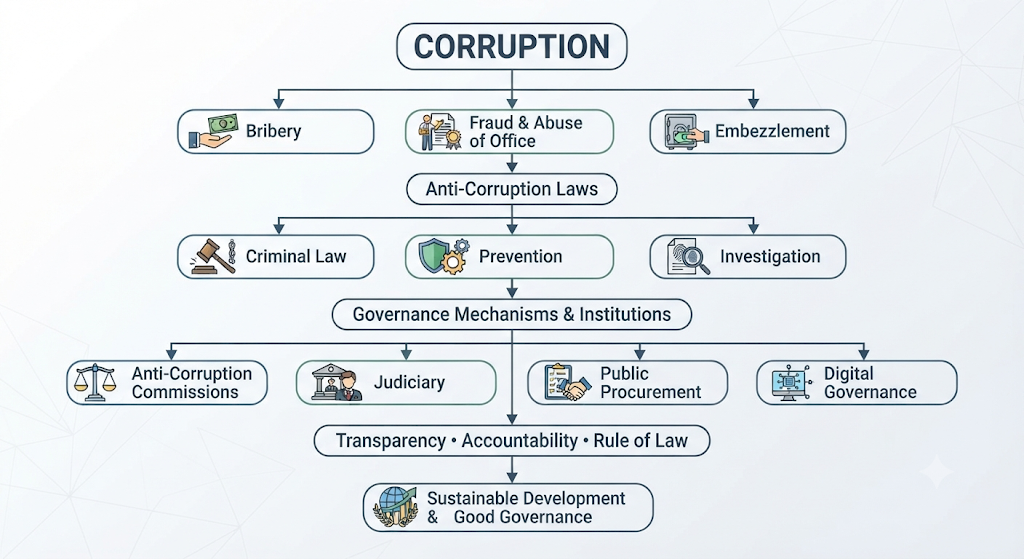
Figure: Anti-Corruption Governance Framework in Developing Countries
Technological innovation has further transformed anti-corruption governance through digital public administration, electronic procurement systems, open government initiatives, online public service delivery, blockchain-based financial monitoring, artificial intelligence-assisted auditing, and digital whistleblower platforms. These innovations enhance transparency, reduce opportunities for discretionary abuse, strengthen financial oversight, and improve citizen participation in governance. Nevertheless, legal and institutional challenges remain significant, including political interference, selective enforcement, limited investigative capacity, inadequate witness protection, judicial delays, insufficient funding, and weak coordination among oversight institutions.
Comparative legal analysis enables a deeper understanding of how different developing countries address these challenges through diverse legislative models, institutional arrangements, enforcement mechanisms, and governance strategies. Examining comparative experiences helps identify best practices while recognizing that anti-corruption reforms must reflect each country's constitutional structure, political culture, administrative capacity, and socio-economic conditions.
This chapter critically examines anti-corruption laws and governance mechanisms across developing countries by analyzing legislative frameworks, institutional models, enforcement practices, judicial oversight, implementation challenges, comparative legal developments, and future prospects for strengthening integrity, accountability, and democratic governance.
Comparative Legal Frameworks and Governance Mechanisms in Developing Countries#
The legal and institutional responses to corruption in developing countries have evolved considerably over the past three decades, reflecting increasing recognition that corruption undermines democratic governance, economic development, public service delivery, and the rule of law. Although most developing countries have enacted anti-corruption legislation consistent with international legal standards, significant differences exist regarding legislative design, institutional capacity, enforcement strategies, and governance mechanisms. A comparative analysis demonstrates that the effectiveness of anti-corruption frameworks depends not merely upon the existence of comprehensive laws but also upon independent institutions, political commitment, judicial integrity, administrative efficiency, public participation, and transparent governance practices. Most developing countries have criminalized core corrupt practices such as bribery, embezzlement, abuse of public office, illicit enrichment, money laundering, influence peddling, procurement fraud, and obstruction of justice. These legislative reforms have largely been influenced by international legal instruments, particularly the United Nations Convention against Corruption (UNCAC), which establishes comprehensive standards relating to prevention, criminalization, international cooperation, asset recovery, and technical assistance. Many national legal systems have incorporated these principles into domestic criminal law while adapting them to constitutional and administrative structures. In India, the legal framework is primarily centered on the Prevention of Corruption Act, 1988 (as amended in 2018), which criminalizes bribery involving public servants, abuse of official position, and possession of disproportionate assets. Complementary legislation such as the Lokpal and Lokayuktas Act, 2013, the Whistle Blowers Protection Act, 2014, the Right to Information Act, 2005, and the Prevention of Money Laundering Act, 2002 strengthens institutional accountability by promoting transparency, citizen participation, financial monitoring, and independent investigation. Institutions including the Central Vigilance Commission, Central Bureau of Investigation, Comptroller and Auditor General, and Lokpal contribute to the country's multi-layered anti-corruption governance system. Indonesia has adopted one of the region's most proactive institutional models through the establishment of the Corruption Eradication Commission (KPK), an independent constitutional body possessing extensive investigative, prosecutorial, preventive, and educational powers. The KPK has earned international recognition for prosecuting high-profile corruption cases involving senior political leaders, legislators, judges, and public officials while promoting integrity education and public awareness. Brazil has implemented comprehensive anti-corruption legislation through the Clean Company Act, fiscal transparency measures, electronic procurement systems, and specialized financial investigation agencies. Large-scale investigations have demonstrated the importance of coordinated institutional cooperation among prosecutors, financial regulators, auditing agencies, and judicial authorities in combating systemic corruption. South Africa has strengthened its constitutional anti-corruption framework through independent oversight institutions such as the Public Protector, National Prosecuting Authority, Special Investigating Unit, Auditor-General, and Constitutional Court. Judicial independence has played a particularly significant role in ensuring governmental accountability and constitutional oversight during politically sensitive corruption investigations. Nigeria has established specialized agencies including the Economic and Financial Crimes Commission (EFCC) and the Independent Corrupt Practices Commission (ICPC), both empowered to investigate financial crimes, corruption, money laundering, advance fee fraud, and illicit enrichment. However, enforcement effectiveness continues to depend upon institutional independence, adequate funding, political support, and judicial efficiency. Across developing countries, anti-corruption commissions constitute one of the most common governance mechanisms. These independent agencies typically perform preventive, investigative, educational, advisory, and prosecutorial functions while promoting public sector ethics, transparency, and institutional accountability. Their effectiveness varies significantly depending upon statutory independence, financial autonomy, investigative powers, political neutrality, staffing capacity, and public confidence. Countries granting constitutional protection and operational independence to anti-corruption agencies generally demonstrate stronger enforcement outcomes than jurisdictions where political interference limits institutional effectiveness. Public procurement reform has emerged as another critical governance mechanism because procurement processes frequently present significant corruption risks involving public expenditure, infrastructure projects, healthcare procurement, and government contracts. Many developing countries have introduced electronic procurement platforms, competitive bidding procedures, public contract disclosure systems, integrity monitoring, and independent procurement oversight bodies to reduce discretionary decision-making and increase transparency. Similarly, asset declaration systems require senior public officials to disclose financial interests, income sources, property ownership, and potential conflicts of interest, thereby facilitating accountability and preventing illicit enrichment. Whistleblower protection legislation has likewise become increasingly important in encouraging the reporting of corruption while protecting individuals from retaliation, discrimination, dismissal, or criminal liability arising from good-faith disclosures. The expansion of digital governance has further strengthened anti-corruption efforts by reducing direct interactions between citizens and public officials, increasing administrative transparency, improving financial monitoring, and facilitating public access to government information. Electronic tax administration, online licensing systems, digital identity platforms, open budget initiatives, blockchain-based record management, artificial intelligence-assisted auditing, and electronic payment systems reduce opportunities for bribery and administrative discretion while improving institutional efficiency. Civil society organizations, investigative journalism, academic institutions, business associations, and independent media also play essential roles in monitoring public administration, exposing corruption, advocating legal reform, and strengthening democratic accountability. Despite these significant legal and institutional developments, comparative analysis demonstrates that legislation alone cannot eliminate corruption. Sustainable success depends upon consistent political commitment, judicial independence, effective enforcement, ethical public administration, active citizen participation, international cooperation, and a culture of integrity supported by transparent governance. Consequently, the comparative experiences of developing countries illustrate that comprehensive anti-corruption strategies must integrate robust legal frameworks with strong institutions, technological innovation, accountable leadership, and meaningful public engagement to achieve lasting improvements in governance and the rule of law.
Implementation Challenges, Judicial Responses, and Comparative Best Practice#
Despite the widespread adoption of comprehensive anti-corruption legislation in developing countries, effective implementation continues to face significant legal, institutional, political, and socio-economic challenges. While many governments have established anti-corruption commissions, specialized investigative agencies, financial intelligence units, public procurement authorities, and judicial oversight mechanisms, corruption remains deeply embedded in several administrative systems due to weak institutional capacity, inadequate enforcement, political interference, limited public accountability, and insufficient resources. Consequently, the effectiveness of anti-corruption laws depends not only upon legislative design but also upon the practical ability of institutions to investigate, prosecute, adjudicate, and prevent corrupt practices consistently and impartially. One of the most significant implementation challenges is political interference. In many developing countries, anti-corruption agencies operate within political environments where powerful public officials or influential political actors may attempt to influence investigations, delay prosecutions, manipulate appointments, or weaken institutional independence. Such interference undermines public confidence in anti-corruption institutions and creates perceptions of selective or politically motivated enforcement. Ensuring statutory independence, secure tenure for institutional leaders, transparent appointment procedures, and adequate financial autonomy is therefore essential for maintaining credibility and operational effectiveness. Another major challenge concerns judicial inefficiency and delays. Corruption cases often involve extensive financial records, complex commercial transactions, international asset transfers, and sophisticated money laundering schemes requiring specialized judicial expertise. Lengthy investigations, procedural delays, case backlogs, inadequate forensic capabilities, and limited judicial resources frequently reduce the deterrent effect of anti-corruption laws. To address these issues, several developing countries have established specialized anti-corruption courts or designated judicial divisions with expertise in financial crimes, thereby improving efficiency, consistency, and timely adjudication. Institutional coordination also presents a significant challenge because anti-corruption efforts typically involve multiple agencies, including police authorities, prosecutors, financial intelligence units, tax administrations, audit institutions, procurement regulators, customs authorities, central banks, and anti-corruption commissions. Weak communication, overlapping mandates, jurisdictional conflicts, and fragmented information-sharing mechanisms can reduce the effectiveness of investigations and enforcement. Developing integrated institutional frameworks, joint investigative teams, centralized databases, and inter-agency coordination mechanisms has therefore emerged as an important governance priority. Financial and technical capacity constraints further limit implementation. Many anti-corruption institutions in developing countries face shortages of trained investigators, prosecutors, forensic accountants, cybersecurity specialists, digital evidence experts, and financial analysts. Limited budgets, outdated investigative technologies, inadequate witness protection programs, and insufficient training reduce the ability of agencies to investigate increasingly sophisticated corruption schemes involving digital transactions, offshore financial structures, shell companies, and cross-border money laundering. Investment in institutional capacity building, professional education, technological modernization, and international technical assistance is therefore essential for strengthening enforcement capabilities. Judicial responses have played a crucial role in reinforcing anti-corruption governance by ensuring constitutional accountability, protecting due process, and strengthening public confidence in legal institutions. Courts in many developing countries have emphasized that anti-corruption measures must remain consistent with constitutional guarantees relating to fair trial, equality before the law, judicial independence, and protection of fundamental rights. Judicial review prevents arbitrary prosecutions while ensuring that investigations are conducted lawfully, transparently, and without political bias. Constitutional courts have also upheld the independence of anti-corruption agencies, reinforced legislative accountability, and clarified legal standards governing public office, conflict of interest, illicit enrichment, and abuse of authority. Comparative experiences reveal several best practices that have significantly improved anti-corruption governance. One of the most successful approaches involves granting anti-corruption commissions operational independence supported by constitutional protection, secure funding, transparent leadership appointments, and clearly defined investigative powers. Institutions operating independently from executive influence generally demonstrate higher public confidence and greater enforcement effectiveness. Another important best practice is the implementation of electronic governance systems, including online procurement platforms, digital tax administration, electronic licensing, integrated financial management systems, open government data portals, and electronic public service delivery. These technologies reduce opportunities for discretionary decision-making, increase administrative transparency, strengthen audit trails, and minimize direct interactions between public officials and citizens where bribery commonly occurs. Public procurement reforms have likewise produced measurable improvements by introducing competitive bidding procedures, contract transparency, independent procurement oversight, and digital procurement platforms that reduce opportunities for favoritism and financial irregularities. Asset declaration systems requiring senior public officials to disclose financial interests, business relationships, and property holdings further enhance transparency while facilitating detection of illicit enrichment and conflicts of interest. Whistleblower protection mechanisms constitute another essential best practice. Effective legal frameworks protect individuals who report corruption from retaliation, dismissal, harassment, discrimination, or criminal liability while encouraging greater public participation in anti-corruption efforts. Anonymous reporting channels, witness protection programs, legal assistance, and confidential complaint mechanisms strengthen institutional accountability and increase detection of corrupt activities. Civil society organizations, investigative journalists, academic researchers, business associations, and independent media further contribute by monitoring government performance, exposing corruption, promoting public awareness, and advocating legal reforms. International cooperation has become increasingly important because corruption frequently involves cross-border financial transactions, offshore assets, multinational corporations, and transnational criminal networks. Mutual legal assistance treaties, asset recovery agreements, extradition arrangements, financial intelligence sharing, and collaboration among international organizations strengthen the ability of developing countries to investigate and recover illicit assets located abroad. Looking forward, sustainable anti-corruption governance requires a comprehensive strategy integrating strong legal frameworks, independent institutions, judicial integrity, technological innovation, ethical public administration, active citizen participation, and international collaboration. Comparative analysis demonstrates that countries achieving lasting reductions in corruption do so not solely through punitive legislation but through sustained institutional reform, transparent governance, accountable leadership, effective judicial oversight, and a long-term commitment to building a culture of integrity, public trust, and constitutional governance.
Emerging Trends and Future Prospects in Anti-Corruption Governance#
The future of anti-corruption governance in developing countries will increasingly depend upon the integration of technological innovation, institutional independence, international cooperation, legal modernization, and active public participation to address increasingly sophisticated forms of corruption. As globalization, digital transformation, and cross-border financial transactions continue expanding, corruption has evolved beyond traditional bribery and embezzlement into complex schemes involving cybercrime, illicit financial flows, cryptocurrency-based money laundering, procurement fraud, tax evasion, shell companies, beneficial ownership concealment, and transnational organized crime. Consequently, governments must develop adaptive legal frameworks capable of responding effectively to these emerging challenges while preserving constitutional principles, human rights, and the rule of law. One of the most significant future trends involves the expansion of digital governance as a preventive anti-corruption strategy. Electronic public administration, online procurement systems, integrated financial management platforms, digital tax administration, blockchain-based land registration, electronic licensing systems, and open government data initiatives reduce direct interactions between citizens and public officials, thereby minimizing opportunities for bribery, favoritism, and administrative discretion. Artificial Intelligence (AI) is expected to become an increasingly valuable tool in anti-corruption governance by enabling automated auditing, predictive fraud detection, anomaly identification, procurement monitoring, financial risk assessment, and real-time analysis of government expenditure. Machine learning algorithms can identify suspicious financial transactions, irregular procurement patterns, conflicts of interest, and tax evasion more efficiently than conventional investigative methods. However, the deployment of AI must remain subject to legal safeguards ensuring transparency, accountability, explainability, protection of personal data, and judicial oversight to prevent misuse or discriminatory outcomes. Blockchain technology likewise presents significant opportunities for strengthening transparency and accountability. Distributed ledger systems create immutable digital records that reduce opportunities for document alteration, procurement manipulation, land registration fraud, and unauthorized financial transactions. Smart contracts may further automate public procurement, grant disbursement, welfare distribution, and contractual compliance while reducing opportunities for corruption arising from manual administrative processes. Future legal reforms are therefore expected to provide clearer regulatory frameworks governing blockchain implementation within public administration while ensuring cybersecurity and data protection. Another emerging trend concerns beneficial ownership transparency. Corrupt officials frequently conceal illicit wealth through shell companies, offshore financial structures, trusts, and nominee ownership arrangements.
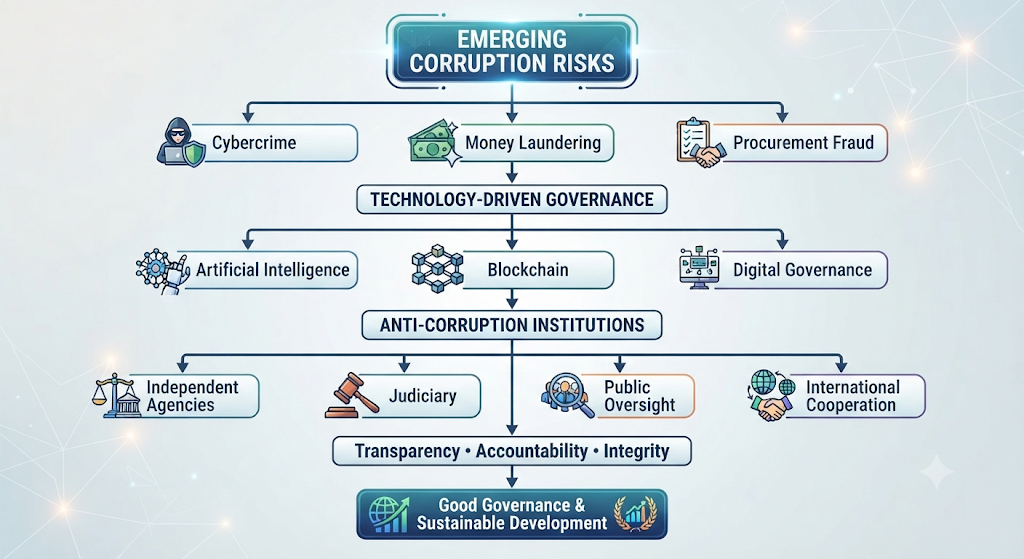
Figure: Future Framework for Anti-Corruption Governance in Developing Countries
Many developing countries are therefore establishing beneficial ownership registries requiring disclosure of individuals who ultimately control companies and financial assets. These measures strengthen financial transparency, facilitate asset recovery, and improve compliance with anti-money laundering standards. International cooperation will become increasingly important because corruption often transcends national borders. Future anti-corruption strategies will rely upon enhanced mutual legal assistance, extradition agreements, financial intelligence sharing, joint investigations, cross-border asset recovery, and collaboration among law enforcement agencies, financial regulators, and international organizations. Global initiatives promoting transparency in banking, taxation, public procurement, and beneficial ownership are expected to reduce opportunities for hiding illicit assets abroad while strengthening international enforcement mechanisms. Judicial institutions will continue playing an essential role in safeguarding constitutional governance and ensuring that anti-corruption enforcement remains impartial, lawful, and consistent with due process. Specialized anti-corruption courts, financial crime divisions, digital evidence management systems, electronic case filing, and judicial training in financial crimes, cybercrime, and digital investigations are expected to improve the efficiency and quality of corruption prosecutions. Judicial independence will remain fundamental to preventing selective enforcement and maintaining public confidence in anti-corruption institutions. Another significant development concerns citizen participation and social accountability. Governments increasingly recognize that sustainable anti-corruption efforts require active involvement from civil society organizations, investigative journalists, academic institutions, professional associations, private sector organizations, and ordinary citizens. Open government initiatives, participatory budgeting, online complaint portals, whistleblower protection platforms, social audits, and freedom of information laws strengthen democratic accountability by enabling citizens to monitor public expenditure, government performance, and administrative decision-making. Educational initiatives promoting ethics, civic responsibility, and integrity within schools, universities, and public institutions will further contribute to developing a long-term culture of transparency and accountability. Environmental, Social, and Governance (ESG) standards are also expected to influence anti-corruption governance by encouraging corporations to adopt stronger compliance systems, ethical business practices, anti-bribery policies, and transparent reporting mechanisms. Multinational corporations increasingly face legal obligations to prevent corruption throughout global supply chains, creating incentives for higher governance standards within developing economies. Nevertheless, future anti-corruption reforms must also address emerging risks associated with digital technologies, including cyber fraud, cryptocurrency laundering, artificial intelligence manipulation, identity theft, and cyber-enabled financial crimes. Legislators must therefore continuously update criminal laws, financial regulations, cybersecurity frameworks, and investigative powers to respond effectively to rapidly evolving technological threats while respecting constitutional rights and privacy protections. Ultimately, the future of anti-corruption governance lies in combining strong legal institutions with innovative technologies, transparent public administration, accountable political leadership, independent judiciaries, active citizen participation, ethical governance, and international cooperation. Developing countries that successfully integrate these elements into comprehensive anti-corruption strategies will be better positioned to strengthen democratic governance, attract sustainable investment, improve public service delivery, enhance economic development, and reinforce the rule of law for future generations.
Conclusion#
Corruption remains one of the most significant challenges confronting developing countries because it weakens democratic institutions, undermines the rule of law, reduces public confidence in government, discourages investment, distorts economic development, and limits the effective delivery of public services. As demonstrated throughout this chapter, corruption extends beyond isolated incidents of bribery or financial misconduct and represents a systemic governance problem that affects political stability, social justice, institutional integrity, and sustainable development. Recognizing these far-reaching consequences, developing countries have undertaken extensive legal and institutional reforms by enacting comprehensive anti-corruption legislation, establishing independent investigative agencies, strengthening judicial oversight, improving financial regulation, and enhancing transparency within public administration. International legal instruments, particularly the United Nations Convention against Corruption (UNCAC), have provided a common legal foundation for harmonizing domestic legislation and promoting international cooperation in combating corruption through preventive measures, criminalization, asset recovery, technical assistance, and cross-border law enforcement. The comparative analysis presented in this chapter demonstrates that while many developing countries possess comprehensive legal frameworks addressing corruption, the effectiveness of these laws depends fundamentally upon political commitment, institutional independence, administrative capacity, judicial integrity, and consistent enforcement. Merely adopting anti-corruption legislation does not guarantee meaningful reductions in corruption unless supported by transparent governance structures, independent oversight institutions, professional investigative agencies, adequately funded judicial systems, and effective public accountability mechanisms. Countries that have achieved measurable progress typically combine strong legal frameworks with operationally independent anti-corruption commissions, specialized financial investigation units, transparent procurement systems, robust audit institutions, whistleblower protection laws, and active citizen participation. The chapter further highlights the increasing importance of digital governance as an essential component of modern anti-corruption strategies. Technologies such as electronic procurement systems, online public services, blockchain-based record management, artificial intelligence-assisted auditing, integrated financial management systems, and open government data platforms significantly reduce opportunities for discretionary decision-making while strengthening transparency, efficiency, and institutional accountability. Nevertheless, these technological innovations also require comprehensive legal safeguards addressing cybersecurity, data protection, digital evidence, algorithmic accountability, and ethical governance. Judicial institutions continue to play an indispensable role in ensuring that anti-corruption measures remain consistent with constitutional principles, due process, judicial independence, and the protection of fundamental rights. Independent courts strengthen public confidence by ensuring impartial adjudication, reviewing governmental actions, protecting institutional autonomy, and preventing politically motivated investigations or prosecutions. International cooperation has likewise become increasingly important because corruption frequently involves cross-border financial transactions, multinational corporations, offshore financial centers, and transnational criminal organizations. Effective anti-corruption governance therefore depends upon mutual legal assistance, information sharing, asset recovery mechanisms, extradition arrangements, beneficial ownership transparency, and collaborative law enforcement among states. Looking toward the future, anti-corruption governance must continue evolving to address emerging threats including cyber-enabled financial crimes, cryptocurrency laundering, digital procurement fraud, artificial intelligence manipulation, and increasingly sophisticated methods of concealing illicit assets. Legislative reform, institutional modernization, judicial capacity building, technological innovation, ethical leadership, and civic education will remain essential components of sustainable anti-corruption strategies. Equally important is the promotion of a culture of integrity through educational institutions, professional ethics, responsible corporate governance, independent media, civil society engagement, and active public participation. Sustainable reductions in corruption require not only effective punishment of offenders but also preventive governance systems that minimize opportunities for corruption before they occur. Ultimately, the comparative experiences of developing countries demonstrate that successful anti-corruption governance is achieved through an integrated approach combining strong legal frameworks, transparent public administration, accountable political leadership, independent institutions, effective judicial oversight, technological advancement, citizen engagement, and international collaboration. By strengthening these interconnected elements, developing countries can improve governance quality, reinforce democratic institutions, enhance economic competitiveness, protect public resources, promote social justice, and uphold the rule of law. Effective anti-corruption governance therefore serves not only as a legal necessity but also as a fundamental prerequisite for sustainable development, constitutional democracy, public trust, and long-term national prosperity.
Works Cited#
- Ackerman, S. R. (2016). Corruption and Government: Causes, Consequences, and Reform (2nd ed.). Cambridge University Press.
- Amundsen, I. (2019). Political Corruption and Institutional Reform in Developing Countries. Chr. Michelsen Institute.
- Asian Development Bank. (2020). Anticorruption Policy: Framework for Action. Asian Development Bank.
- Doig, A., Watt, D., & Williams, R. (2007). Measuring “success” in five African anti-corruption commissions: The cases of Ghana, Malawi, Tanzania, Uganda, and Zambia. U4 Anti-Corruption Resource Centre Report, 2007(1), 1–48.
- European Commission. (2023). Anti-Corruption Report: Strengthening Integrity and Public Accountability. European Union.
- Heeks, R. (2008). Success and failure rates of e-government in developing and transitional countries. Government Information Quarterly, 25(1), 26–35.
- Johnston, M. (2014). Corruption, Contention and Reform: The Power of Deep Democratization. Cambridge University Press.
- Kaufmann, D., Kraay, A., & Mastruzzi, M. (2011). The Worldwide Governance Indicators: Methodology and Analytical Issues. Hague Journal on the Rule of Law, 3(2), 220–246.
- Klitgaard, R. (1988). Controlling Corruption. University of California Press.
- Organisation for Economic Co-operation and Development. (2021). OECD Public Integrity Handbook. OECD Publishing.
- Organisation for Economic Co-operation and Development. (2023). Government at a Glance 2023. OECD Publishing.
- Pope, J. (2000). Confronting Corruption: The Elements of a National Integrity System. Transparency International.
- Rose-Ackerman, S., & Palifka, B. J. (2016). Corruption and Government: Causes, Consequences, and Reform (2nd ed.). Cambridge University Press.
- Transparency International. (2024). Corruption Perceptions Index 2024. Transparency International.
- United Nations Development Programme. (2018). Anti-Corruption for Peaceful and Inclusive Societies. UNDP.
- United Nations Office on Drugs and Crime. (2004). United Nations Convention against Corruption. United Nations.
- United Nations Office on Drugs and Crime. (2022). State of Implementation of the United Nations Convention against Corruption. United Nations.
- World Bank. (2017). Helping Countries Combat Corruption: The Role of the World Bank. World Bank.
- World Bank. (2023). Worldwide Governance Indicators. World Bank.
- World Justice Project. (2024). Rule of Law Index 2024. World Justice Project