Abstract
Corporate Social Responsibility (CSR) has evolved from a voluntary ethical practice into an integral component of modern corporate governance and sustainable business regulation. Increasing globalization, environmental degradation, climate change, human rights concerns, and stakeholder expectations have compelled corporations to extend their responsibilities beyond profit maximization toward broader social, environmental, and economic objectives. Simultaneously, the concept of sustainable development has emerged as a guiding principle requiring businesses to balance economic growth with environmental protection and social equity. Governments across the world have increasingly incorporated CSR obligations into legal and regulatory frameworks through corporate governance laws, environmental regulations, labour standards, human rights obligations, and sustainability reporting requirements. The adoption of Environmental, Social, and Governance (ESG) principles has further strengthened corporate accountability by encouraging transparent business practices and responsible investment decisions. This paper critically examines the legal dimensions of Corporate Social Responsibility and its contribution to sustainable development through a comparative analysis of legal frameworks in India, the European Union, the United States, and other major jurisdictions. It explores statutory CSR obligations, judicial interpretations, corporate governance reforms, sustainability reporting mechanisms, and international initiatives such as the United Nations Sustainable Development Goals (SDGs), the United Nations Global Compact, and the OECD Guidelines for Multinational Enterprises. The paper also discusses contemporary challenges relating to regulatory compliance, greenwashing, corporate accountability, environmental protection, and stakeholder participation. It concludes that effective CSR governance requires comprehensive legal frameworks, transparent corporate practices, responsible leadership, and strong regulatory enforcement to ensure that business enterprises contribute meaningfully to sustainable economic development, environmental conservation, and long-term social welfare.
- Corporate Social Responsibility
- Sustainable Development
- Corporate Governance
- ESG
- Business Ethics
- Environmental Law
- Stakeholder Theory
- Sustainable Business
- Corporate Accountability
- SDGs
Introduction#
Corporate Social Responsibility (CSR) has become one of the most significant developments in modern corporate governance as businesses increasingly recognize their responsibility toward society, the environment, and future generations. Traditionally, corporations were viewed primarily as economic institutions whose principal objective was profit maximization and shareholder wealth creation. However, globalization, industrialization, technological advancement, environmental degradation, climate change, labour exploitation, and increasing public awareness have fundamentally transformed expectations regarding corporate conduct. Today, businesses are expected not only to generate financial returns but also to contribute positively to social welfare, environmental sustainability, ethical governance, and inclusive economic development. Corporate Social Responsibility therefore represents a comprehensive framework through which organizations voluntarily and, in many jurisdictions, legally integrate social, environmental, and ethical considerations into their business operations and stakeholder relationships. Governments, international organizations, investors, consumers, and civil society increasingly demand responsible corporate behaviour that promotes transparency, accountability, human rights protection, environmental conservation, and sustainable resource management. Consequently, CSR has evolved from a voluntary philanthropic initiative into a significant legal and regulatory obligation within modern business governance. Legislative measures concerning environmental protection, labour welfare, consumer rights, anti-corruption practices, sustainability reporting, and corporate governance now require businesses to adopt responsible operational practices. Furthermore, international frameworks such as the United Nations Global Compact, the OECD Guidelines for Multinational Enterprises, the International Labour Organization (ILO) conventions, and the United Nations Sustainable Development Goals (SDGs) have strengthened the global movement toward responsible business conduct.
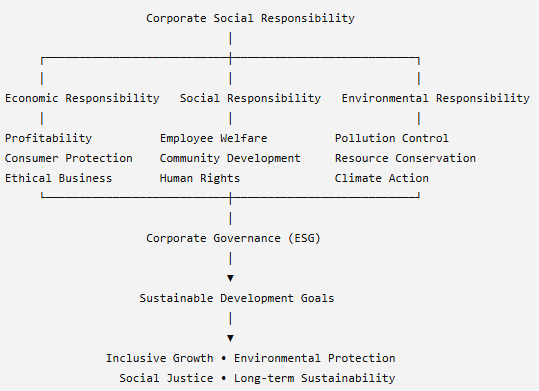
Figure: Conceptual Background
The relationship between Corporate Social Responsibility and sustainable development has become increasingly significant in contemporary legal discourse. Sustainable development seeks to balance economic growth, environmental protection, and social equity while ensuring that the needs of present generations are met without compromising the ability of future generations to meet their own needs. Businesses play a crucial role in achieving these objectives because their activities directly influence natural resource utilization, employment generation, technological innovation, environmental quality, and community development. In recent years, Environmental, Social, and Governance (ESG) principles have emerged as an important mechanism for evaluating corporate sustainability performance, influencing investment decisions, and enhancing long-term business resilience. Countries such as India have pioneered mandatory CSR legislation by requiring eligible companies to allocate a specified percentage of their profits toward socially beneficial activities, while the European Union has introduced comprehensive sustainability reporting and corporate due diligence requirements. Courts and regulatory authorities increasingly interpret corporate obligations in light of constitutional values, environmental principles, and stakeholder interests, thereby expanding corporate accountability beyond traditional shareholder-centric models. Nevertheless, challenges such as regulatory inconsistencies, inadequate enforcement, greenwashing, insufficient stakeholder participation, and balancing profitability with sustainability continue to affect the effective implementation of CSR initiatives. This paper critically examines the evolving legal framework governing Corporate Social Responsibility and sustainable development through a comparative analysis of national and international legal systems. It explores statutory obligations, judicial developments, international standards, corporate governance reforms, and emerging legal trends while highlighting the growing importance of responsible business governance in achieving sustainable economic development, environmental protection, and social justice.
Corporate Governance, ESG, and Emerging Challenges in Sustainable Business#
Corporate governance has become a fundamental pillar of Corporate Social Responsibility (CSR) and sustainable development by ensuring that corporations operate with accountability, transparency, ethical integrity, and long-term stakeholder value. Modern corporate governance extends beyond traditional shareholder wealth maximization to embrace the interests of employees, consumers, investors, local communities, regulators, and the environment. This transition has been accelerated by the growing adoption of Environmental, Social, and Governance (ESG) principles, which have emerged as internationally recognized standards for evaluating corporate sustainability and responsible business practices. The environmental dimension of ESG focuses on climate change mitigation, carbon emission reduction, biodiversity conservation, waste management, renewable energy adoption, and sustainable resource utilization. The social dimension emphasizes labour rights, workplace diversity, employee welfare, gender equality, consumer protection, community development, and respect for human rights throughout corporate operations and supply chains. Governance relates to ethical leadership, board independence, executive accountability, anti-corruption measures, shareholder protection, regulatory compliance, and transparent corporate reporting. Together, these three pillars provide a comprehensive framework for measuring corporate performance beyond financial profitability while supporting the broader objectives of sustainable development. Investors increasingly rely upon ESG performance indicators to evaluate business resilience, financial stability, and long-term investment potential, making sustainability an essential component of corporate competitiveness. Simultaneously, governments and regulatory authorities have introduced mandatory sustainability reporting frameworks requiring companies to disclose environmental impacts, climate-related financial risks, human rights practices, and governance structures. Such disclosures enhance market transparency and enable stakeholders to assess whether businesses genuinely contribute to sustainable development. Despite these advances, several legal and practical challenges continue to hinder the effective implementation of CSR and ESG obligations. One major concern is **greenwashing**, whereby corporations exaggerate or misrepresent their environmental achievements without implementing meaningful sustainability measures. Greenwashing undermines consumer confidence, distorts investment decisions, and weakens the credibility of sustainability initiatives. Another challenge involves inconsistent ESG reporting standards across jurisdictions, making cross-border comparisons difficult and reducing the reliability of sustainability disclosures. Supply chain governance presents additional legal complexities, as multinational corporations increasingly face scrutiny regarding labour exploitation, child labour, unsafe working conditions, environmental degradation, and human rights violations occurring within global supply networks. Climate change has further intensified expectations that corporations should actively reduce greenhouse gas emissions, transition toward renewable energy, and align business strategies with international climate commitments. Digital transformation and emerging technologies such as artificial intelligence, blockchain, and big data analytics are also reshaping corporate governance by improving compliance monitoring, sustainability reporting, risk assessment, and stakeholder engagement. However, these technologies simultaneously introduce concerns relating to data privacy, cybersecurity, algorithmic transparency, and ethical decision-making. Another significant issue concerns balancing short-term financial objectives with long-term sustainability investments, as many corporations continue to prioritize immediate profitability over environmental and social responsibilities. Small and medium-sized enterprises (SMEs) often encounter additional challenges due to limited financial resources, inadequate technical expertise, and regulatory compliance costs associated with ESG implementation. Consequently, governments increasingly promote incentives such as tax benefits, sustainability-linked financing, green investments, and capacity-building initiatives to encourage responsible business practices. Looking ahead, the future of corporate governance lies in integrating legal compliance, ethical leadership, stakeholder participation, technological innovation, and sustainability into a unified governance model. Strengthening regulatory oversight, harmonizing international ESG standards, improving sustainability assurance mechanisms, and promoting responsible corporate culture will be essential for ensuring that CSR contributes effectively to sustainable development. Ultimately, modern corporate governance must evolve from a compliance-based approach toward a value-driven framework that simultaneously promotes economic prosperity, environmental conservation, social justice, and long-term business resilience.
Comparative Analysis and Emerging Trends in Corporate Social Responsibility and Sustainable Development#
The legal regulation of Corporate Social Responsibility (CSR) has evolved differently across jurisdictions, reflecting diverse legal traditions, economic priorities, and approaches to corporate governance. Nevertheless, a common global trend is the gradual transition from voluntary CSR initiatives to mandatory sustainability obligations supported by statutory regulation, judicial oversight, and international standards. India has emerged as a global pioneer by introducing mandatory CSR through **Section 135 of the Companies Act, 2013**, which requires qualifying companies to allocate at least two percent of their average net profits toward approved social development activities. This legislative innovation has significantly institutionalized CSR within corporate governance by encouraging investments in education, healthcare, rural development, environmental conservation, women’s empowerment, and poverty alleviation. The European Union (EU) has adopted a broader sustainability-driven approach through the **Corporate Sustainability Reporting Directive (CSRD)** and the **Corporate Sustainability Due Diligence Directive (CSDDD)**, requiring companies to disclose environmental, social, and governance (ESG) information while identifying, preventing, and mitigating adverse human rights and environmental impacts throughout their global supply chains. These regulations emphasize transparency, corporate accountability, stakeholder protection, and long-term sustainable value creation.
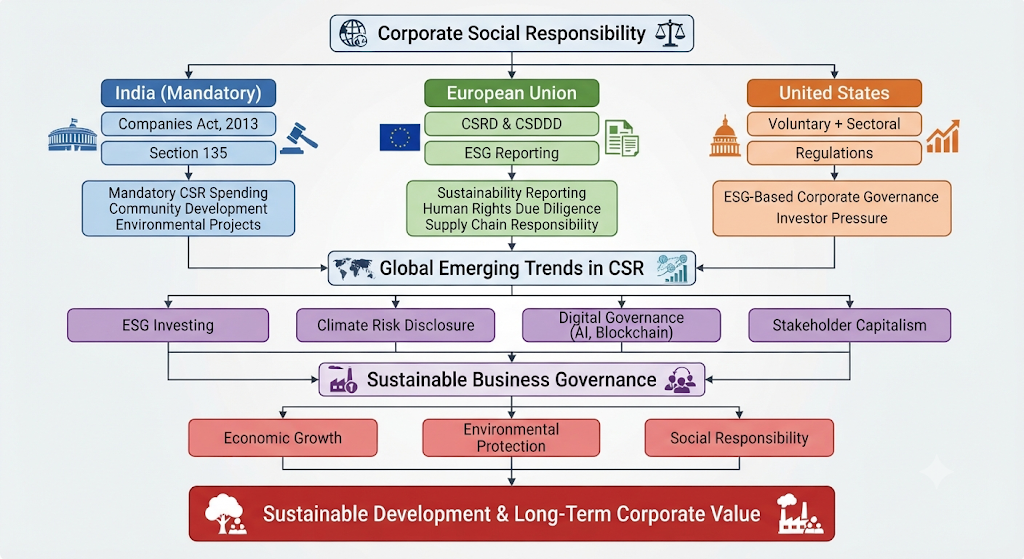
Figure: Comparative CSR & Sustainable Development Framework
In contrast, the United States largely follows a market-oriented model in which CSR remains primarily voluntary, although several federal and state laws relating to securities regulation, environmental protection, labour rights, anti-corruption, and consumer protection indirectly impose social and environmental responsibilities upon corporations. Increasing pressure from institutional investors, consumers, and regulatory agencies has nevertheless encouraged American companies to adopt ESG reporting and sustainability frameworks voluntarily. Countries such as the United Kingdom, Australia, Canada, Germany, Japan, and South Africa have similarly strengthened corporate governance through mandatory non-financial disclosures, climate-related financial reporting, modern slavery legislation, and responsible investment policies. These comparative developments illustrate a growing international consensus that responsible corporate conduct should extend beyond legal compliance to encompass ethical governance, environmental stewardship, and social responsibility. Another significant global trend is the rapid expansion of ESG investing, whereby investors increasingly assess corporate sustainability performance before making investment decisions. Financial institutions now consider environmental risks, climate resilience, human rights compliance, board diversity, and governance quality as important indicators of long-term financial stability and corporate resilience. Simultaneously, climate change litigation and human rights litigation against corporations have increased substantially, holding businesses accountable for excessive greenhouse gas emissions, environmental degradation, labour exploitation, and inadequate sustainability disclosures. Digital transformation has further reshaped CSR governance through artificial intelligence, blockchain technology, big data analytics, and digital reporting platforms, enabling real-time monitoring of supply chains, carbon emissions, and regulatory compliance. However, these technological advancements also raise concerns regarding cybersecurity, data protection, algorithmic transparency, and ethical governance. One of the most pressing contemporary challenges remains greenwashing, where corporations present misleading sustainability claims without implementing substantive environmental improvements. Regulatory authorities worldwide are therefore strengthening sustainability reporting standards and imposing stricter penalties for misleading environmental disclosures. Emerging legal developments also include mandatory climate risk disclosure, biodiversity reporting, circular economy regulations, carbon neutrality commitments, and enhanced due diligence obligations for multinational enterprises. Furthermore, stakeholder capitalism has gained increasing acceptance by recognizing that corporations owe responsibilities not only to shareholders but also to employees, consumers, local communities, governments, and future generations. Despite differences in national legal frameworks, the overall direction of corporate governance reflects an increasing convergence toward responsible, transparent, and sustainable business practices. The future of CSR therefore lies in harmonizing international legal standards, strengthening regulatory enforcement, encouraging innovation, and integrating sustainability into every aspect of corporate decision-making to promote inclusive economic development, environmental protection, and long-term global prosperity.
Conclusion#
Corporate Social Responsibility (CSR) has undergone a remarkable transformation from a voluntary philanthropic initiative to a legally recognized and strategically significant component of modern corporate governance. As globalization, technological advancement, climate change, environmental degradation, and increasing stakeholder expectations continue to reshape the business landscape, corporations are expected to balance economic objectives with social welfare and environmental sustainability. This study has demonstrated that CSR and sustainable development are closely interconnected, with legal frameworks playing a critical role in ensuring responsible corporate conduct. National legislations, international conventions, environmental regulations, labour standards, and corporate governance principles collectively establish a comprehensive framework that encourages businesses to integrate ethical practices into their operational and strategic decision-making processes. The comparative analysis of India, the European Union, the United States, and other jurisdictions reveals a gradual global shift from voluntary CSR initiatives toward mandatory sustainability reporting, environmental due diligence, and enhanced corporate accountability. India’s statutory CSR framework under the Companies Act, 2013 represents a pioneering legislative model, while the European Union has strengthened corporate responsibility through comprehensive Environmental, Social, and Governance (ESG) reporting and sustainability due diligence obligations. Simultaneously, international initiatives such as the United Nations Sustainable Development Goals (SDGs), the United Nations Global Compact, the OECD Guidelines for Multinational Enterprises, and International Labour Organization conventions continue to influence national legal systems and corporate governance reforms. The growing importance of ESG investing, stakeholder capitalism, climate-related financial disclosures, and sustainable supply chain management further demonstrates that responsible business conduct has become essential for long-term corporate success and economic resilience. Nevertheless, significant challenges remain, including inconsistent global regulatory standards, inadequate enforcement mechanisms, greenwashing practices, climate risks, supply chain vulnerabilities, and balancing profitability with sustainability objectives. Addressing these challenges requires stronger legal enforcement, harmonized international sustainability standards, transparent reporting frameworks, independent corporate oversight, and greater stakeholder participation. Emerging technologies such as artificial intelligence, blockchain, big data analytics, and digital compliance systems also offer new opportunities to improve corporate transparency, regulatory compliance, and sustainability monitoring. Ultimately, sustainable business governance depends upon integrating legal obligations with ethical leadership, innovation, and stakeholder engagement. Corporate Social Responsibility should therefore be viewed not merely as a statutory compliance requirement but as a strategic governance framework capable of generating long-term value for businesses, society, and the environment. By strengthening corporate accountability and embedding sustainability into business operations, governments, corporations, investors, and civil society can collectively contribute to inclusive economic growth, environmental conservation, social justice, and the achievement of sustainable development for present and future generations.
Works Cited#
- Carroll, A. B. (1991). The pyramid of corporate social responsibility: Toward the moral management of organizational stakeholders. Business Horizons, 34(4), 39–48.
- Carroll, A. B., & Brown, J. A. (2018). Corporate social responsibility: Perspectives on the CSR construct's development and future. Business & Society.
- Crane, A., Matten, D., Glozer, S., & Spence, L. J. (2022). Business ethics: Managing corporate citizenship and sustainability in the age of globalization (6th ed.). Oxford University Press.
- European Commission. (2022). Corporate Sustainability Reporting Directive (CSRD). https://finance.ec.europa.eu
- European Commission. (2024). Corporate Sustainability Due Diligence Directive (CSDDD). https://commission.europa.eu
- Freeman, R. E. (2010). Strategic management: A stakeholder approach. Cambridge University Press.
- Gond, J. P., El Akremi, A., Swaen, V., & Babu, N. (2017). The psychological microfoundations of corporate social responsibility. Human Relations, 70(2), 225–246.
- International Labour Organization. (2022). ILO declaration on fundamental principles and rights at work. https://www.ilo.org
- Organisation for Economic Co-operation and Development. (2023). OECD Guidelines for Multinational Enterprises on Responsible Business Conduct. https://www.oecd.org
- Porter, M. E., & Kramer, M. R. (2011). Creating shared value. Harvard Business Review, 89(1–2), 62–77.
- Scherer, A. G., & Palazzo, G. (2011). The new political role of business in a globalized world. Journal of Management Studies, 48(4), 899–931.
- United Nations. (2015). Transforming our world: The 2030 Agenda for Sustainable Development. https://sdgs.un.org
- United Nations Global Compact. (2023). The ten principles of the UN Global Compact. https://unglobalcompact.org
- Visser, W. (2014). CSR 2.0: Transforming corporate sustainability and responsibility. Springer.
- World Business Council for Sustainable Development. (2021). Vision 2050: Time to transform. https://www.wbcsd.org
- World Economic Forum. (2023). Global risks report 2023. https://www.weforum.org
- Elkington, J. (1997). Cannibals with forks: The triple bottom line of 21st century business. Capstone.
- Eccles, R. G., & Klimenko, S. (2019). The investor revolution. Harvard Business Review, 97(3), 106–116.
- Companies Act, 2013 (India), §135.
- ISO. (2021). ISO 26000: Guidance on social responsibility. https://www.iso.org