Abstract
Artificial Intelligence (AI) has emerged as a transformative technology in the healthcare sector, revolutionizing medical diagnosis, treatment planning, disease prediction, robotic surgery, personalized medicine, and healthcare administration. AI-driven technologies improve clinical efficiency, reduce human error, accelerate drug discovery, and enhance patient outcomes through data-driven decision-making. However, the widespread adoption of AI in healthcare has introduced complex legal, ethical, and regulatory challenges that existing healthcare laws often struggle to address. Issues relating to patient privacy, informed consent, algorithmic transparency, liability for medical errors, data ownership, cybersecurity, bias in AI algorithms, and cross-border data governance have become central concerns in contemporary health law. As AI systems increasingly participate in clinical decision-making, determining accountability among healthcare professionals, software developers, medical institutions, and regulatory authorities becomes legally complex. Several jurisdictions, including the European Union, the United States, India, and the United Kingdom, have introduced regulatory frameworks to ensure the safe, ethical, and responsible deployment of AI-powered healthcare technologies. This paper critically examines the legal regulation of Artificial Intelligence in healthcare through a comparative analysis of international legal frameworks, judicial developments, and ethical principles governing AI-enabled medical systems. It explores the opportunities AI presents for improving healthcare delivery while evaluating the legal challenges surrounding privacy, liability, fairness, transparency, and patient rights. The study concludes by proposing future regulatory reforms aimed at establishing comprehensive, accountable, and human-centric governance frameworks that promote innovation while protecting fundamental rights and ensuring ethical healthcare delivery in the digital era.
- Artificial Intelligence
- Healthcare Law
- Medical Ethics
- Data Privacy
- Medical Liability
- AI Regulation
- Patient Rights
- Digital Health
- Health Law
- Comparative Legal Analysis
Introduction#
Artificial Intelligence (AI) has become one of the most significant technological innovations transforming modern healthcare systems worldwide. By integrating machine learning, deep learning, natural language processing, robotics, and predictive analytics into medical practice, AI has enhanced the efficiency, accuracy, and accessibility of healthcare services. AI-powered applications are now routinely used in disease diagnosis, medical imaging, precision medicine, robotic-assisted surgery, drug discovery, clinical decision support, remote patient monitoring, electronic health records, and public health surveillance. These technologies enable healthcare providers to analyze vast amounts of medical data, identify disease patterns, predict treatment outcomes, and deliver personalized healthcare solutions more efficiently than traditional methods. The COVID-19 pandemic further accelerated the adoption of AI technologies in healthcare by supporting disease surveillance, vaccine development, patient triage, telemedicine, and epidemiological forecasting. Consequently, governments, hospitals, pharmaceutical companies, and technology firms continue to invest substantially in AI-driven healthcare infrastructure to improve patient care and reduce operational costs.
Despite these significant advancements, the growing integration of AI into healthcare has generated complex legal, ethical, and regulatory concerns. Unlike conventional medical devices or clinical decision-support tools, AI systems frequently operate through autonomous or semi-autonomous decision-making processes that rely upon continuous learning from large datasets. This creates uncertainty regarding legal responsibility when AI-generated recommendations contribute to incorrect diagnoses, inappropriate treatment decisions, or patient harm. Determining liability among physicians, hospitals, software developers, AI manufacturers, and healthcare institutions presents one of the most challenging questions in modern health law.
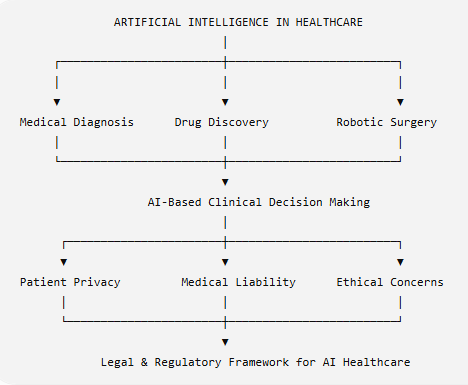
Figure: Conceptual Background
Additionally, AI systems require access to extensive volumes of sensitive health information, raising concerns regarding patient privacy, informed consent, cybersecurity, confidentiality, cross-border data transfers, and ownership of medical data. Algorithmic bias resulting from incomplete or unrepresentative datasets may also lead to discriminatory healthcare outcomes affecting vulnerable populations, thereby challenging principles of equality and non-discrimination. Ethical issues relating to transparency, explainability, fairness, accountability, human oversight, and preservation of the physician-patient relationship further complicate the responsible deployment of AI technologies in healthcare. Recognizing these challenges, several jurisdictions have begun developing comprehensive legal frameworks governing AI-enabled healthcare. The European Union has adopted the General Data Protection Regulation (GDPR) and the Artificial Intelligence Act to regulate high-risk AI applications, while the United States relies upon sector-specific healthcare regulations and oversight by agencies such as the Food and Drug Administration. India has strengthened digital health governance through the Digital Personal Data Protection Act, 2023, and initiatives supporting responsible AI development. International organizations including the World Health Organization, UNESCO, the Organisation for Economic Co-operation and Development, and the United Nations have similarly issued ethical guidelines promoting trustworthy and human-centric AI. This paper critically examines the legal regulation of Artificial Intelligence in healthcare through a comparative analysis of international legal frameworks, ethical principles, judicial developments, and emerging regulatory approaches. It evaluates the opportunities offered by AI alongside the legal challenges that accompany its deployment and proposes future reforms necessary to establish transparent, accountable, and rights-based governance capable of supporting innovation while safeguarding patient welfare and fundamental human rights.
International and Comparative Legal Framework Governing Artificial Intelligence in Healthcare#
The rapid integration of Artificial Intelligence (AI) into healthcare has prompted governments, international organizations, and regulatory authorities to establish legal frameworks that ensure the safe, ethical, and accountable use of AI-powered medical technologies. Although no comprehensive international treaty exclusively regulates AI in healthcare, several international legal instruments provide the foundation for protecting patients' rights, privacy, and human dignity. The Universal Declaration of Human Rights (UDHR) recognizes the rights to life, dignity, equality, and privacy, while the International Covenant on Civil and Political Rights (ICCPR) safeguards individuals against arbitrary interference with privacy. These principles are particularly relevant because AI systems rely extensively on sensitive personal health information to train algorithms and support clinical decision-making. The World Health Organization (WHO) has issued guidance emphasizing that AI in healthcare should be transparent, explainable, safe, inclusive, sustainable, and subject to meaningful human oversight. Similarly, UNESCO's Recommendation on the Ethics of Artificial Intelligence (2021) establishes global ethical standards promoting fairness, accountability, non-discrimination, privacy protection, and respect for human rights in AI deployment. The Organisation for Economic Co-operation and Development (OECD) has also adopted AI Principles encouraging trustworthy AI through transparency, robustness, accountability, and responsible innovation. Among regional frameworks, the European Union has developed the most comprehensive regulatory system through the General Data Protection Regulation (GDPR) and the Artificial Intelligence Act (AI Act). The GDPR regulates the processing of personal health data by requiring lawful processing, informed consent, data minimization, purpose limitation, and strong cybersecurity measures. The AI Act classifies many healthcare AI applications as "high-risk" systems, requiring developers and healthcare providers to conduct risk assessments, ensure transparency, maintain human oversight, and demonstrate compliance before deployment. In the United States, AI regulation relies on a combination of sector-specific laws rather than a single comprehensive statute. The Health Insurance Portability and Accountability Act (HIPAA) governs patient data privacy and security, while the Food and Drug Administration (FDA) regulates AI-enabled Software as a Medical Device (SaMD), ensuring that AI-based diagnostic and treatment systems meet standards of safety and effectiveness before clinical use. In India, healthcare AI regulation is evolving through the Digital Personal Data Protection Act, 2023, the National Digital Health Mission, and policy initiatives promoting responsible AI innovation while safeguarding patient privacy and data security. The landmark judgment in Justice K.S. Puttaswamy (Retd.) v. Union of India (2017) further strengthened the constitutional protection of privacy, directly influencing AI governance involving health data. Other jurisdictions, including the United Kingdom, Canada, Australia, Japan, and Singapore, have similarly introduced privacy legislation, medical device regulations, and AI governance frameworks addressing algorithmic accountability, patient consent, and cybersecurity. Comparative legal analysis demonstrates an emerging international consensus that AI in healthcare must operate within robust legal safeguards emphasizing transparency, fairness, explainability, human oversight, data protection, accountability, and patient autonomy. As AI technologies continue to evolve, harmonization of international legal standards will become increasingly essential for promoting innovation while protecting fundamental rights and ensuring public confidence in AI-enabled healthcare systems.
Legal Challenges, Opportunities, and Ethical Considerations of AI in Healthcare#
The widespread adoption of Artificial Intelligence in healthcare offers unprecedented opportunities to improve medical services while simultaneously creating significant legal and ethical challenges that require comprehensive regulatory responses. One of the most important legal issues concerns medical liability. When AI systems contribute to diagnostic errors, incorrect treatment recommendations, or surgical complications, determining responsibility becomes increasingly difficult. Liability may potentially extend to physicians, hospitals, software developers, AI manufacturers, or healthcare institutions depending upon the degree of human involvement and system autonomy. Existing medical negligence laws were developed primarily for human decision-making and often provide limited guidance for AI-assisted healthcare. Another major concern relates to patient privacy and data protection. AI systems require access to enormous quantities of electronic health records, genomic information, medical imaging, and biometric data to function effectively. Improper collection, storage, sharing, or processing of such sensitive information increases the risks of data breaches, unauthorized access, identity theft, and misuse of confidential medical records. Compliance with data protection laws therefore becomes essential for safeguarding patient confidentiality and maintaining public trust. Informed consent also presents new legal challenges because patients may not fully understand how AI systems analyze their health information or contribute to clinical decisions. Healthcare providers must therefore ensure that patients receive clear information regarding the role of AI, the nature of automated decision-making, potential risks, and available alternatives before consent is obtained. Ethical concerns regarding algorithmic bias and discrimination have likewise become increasingly significant. AI systems trained on incomplete, inaccurate, or unrepresentative datasets may generate unequal healthcare outcomes affecting women, racial minorities, elderly patients, or economically disadvantaged populations. Such bias may undermine the principles of equality, justice, and non-discrimination that form the foundation of healthcare ethics and human rights law. Transparency and explainability represent additional challenges because many advanced AI models operate as complex "black-box" systems whose decision-making processes cannot easily be interpreted by physicians or patients. The inability to explain AI-generated recommendations may weaken clinical accountability, reduce patient confidence, and complicate judicial review in medical negligence litigation. Despite these concerns, AI also creates substantial opportunities for healthcare improvement. AI-assisted diagnostics enable earlier detection of diseases such as cancer, cardiovascular disorders, and neurological conditions with remarkable accuracy. Machine learning accelerates drug discovery, personalized medicine, and precision treatment planning while reducing healthcare costs and improving resource allocation. AI-powered telemedicine expands access to quality healthcare in remote and underserved regions, thereby promoting greater healthcare equity. Predictive analytics further assists governments in monitoring disease outbreaks, planning public health interventions, and responding to future pandemics more effectively. Ethical governance therefore requires balancing innovation with the protection of patient rights through legal safeguards emphasizing transparency, accountability, fairness, cybersecurity, human oversight, professional responsibility, and respect for human dignity. Establishing such balanced regulatory frameworks will ensure that Artificial Intelligence serves as a valuable tool supporting healthcare professionals rather than replacing human judgment, thereby promoting safe, equitable, and trustworthy healthcare systems in the digital age.
Emerging Regulatory Reforms and Future Directions for Artificial Intelligence in Healthcare#
The rapid advancement of Artificial Intelligence (AI) in healthcare has accelerated global efforts to develop comprehensive regulatory frameworks that promote innovation while ensuring patient safety, ethical governance, and legal accountability. Existing healthcare regulations, which were primarily designed for conventional medical devices and physician-led decision-making, are increasingly inadequate for addressing the complexities associated with autonomous and continuously learning AI systems. Consequently, policymakers are adopting a risk-based regulatory approach, whereby AI applications used in diagnosis, treatment planning, robotic surgery, and clinical decision support are classified according to their potential impact on patient health and safety. High-risk AI systems are expected to undergo rigorous clinical validation, algorithmic testing, cybersecurity assessments, post-market monitoring, and continuous regulatory oversight before being approved for medical use. A major area of reform is the adoption of Explainable Artificial Intelligence (XAI), which seeks to improve transparency by enabling healthcare professionals and patients to understand how AI systems generate clinical recommendations. Explainability not only enhances patient trust but also facilitates judicial review, regulatory compliance, and professional accountability when adverse medical outcomes occur. Another emerging trend involves the incorporation of privacy-by-design and security-by-design principles into AI-enabled healthcare systems. These approaches require developers to integrate data protection, encryption, anonymization, access controls, and cybersecurity safeguards during the design phase rather than as post-deployment measures. Governments are also strengthening legal requirements for algorithmic audits, bias testing, and fairness assessments to minimize discriminatory outcomes arising from incomplete or unrepresentative training datasets. Independent regulatory bodies are increasingly expected to supervise AI deployment through periodic compliance reviews, ethical evaluations, certification procedures, and post-market surveillance mechanisms. International cooperation has become equally important because AI technologies frequently rely on cross-border data flows, cloud computing, multinational software developers, and globally distributed healthcare systems. Organizations such as the World Health Organization (WHO), UNESCO, the Organisation for Economic Co-operation and Development (OECD), and the International Medical Device Regulators Forum (IMDRF) continue to promote harmonized international standards governing AI safety, transparency, accountability, interoperability, and patient protection.
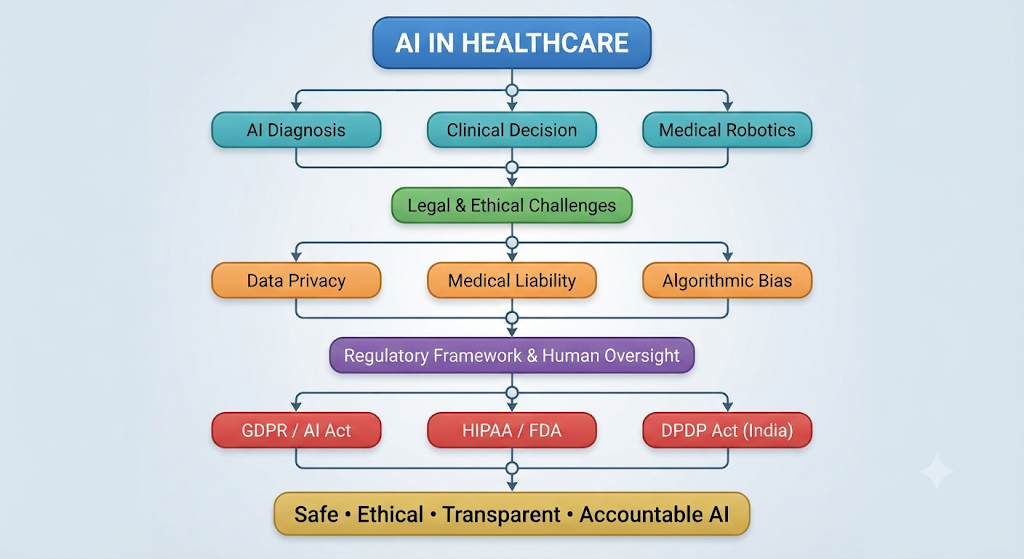
Figure: Regulatory Framework for AI in Healthcare
Future regulatory reforms are also expected to encourage the use of federated learning, privacy-enhancing technologies, blockchain-based medical records, and secure data-sharing frameworks that enable AI model development without compromising patient confidentiality. Additionally, greater emphasis is being placed on multidisciplinary governance involving healthcare professionals, legal experts, ethicists, data scientists, regulators, and patient representatives to ensure balanced policymaking. Continuous education and professional training regarding AI ethics, legal compliance, and responsible innovation will become essential for healthcare practitioners adapting to increasingly AI-driven clinical environments. Ultimately, the future success of Artificial Intelligence in healthcare depends upon establishing adaptive, transparent, and human-centric legal frameworks that encourage technological innovation while preserving patient autonomy, privacy, safety, equality, and public confidence. Such reforms will enable AI to function as a reliable clinical support tool that complements, rather than replaces, professional medical judgment and ethical healthcare practice.
Conclusion#
Artificial Intelligence has fundamentally transformed modern healthcare by enhancing diagnostic accuracy, improving clinical decision-making, accelerating drug discovery, supporting personalized medicine, and expanding access to healthcare services through intelligent digital technologies. The integration of machine learning, deep learning, robotics, and predictive analytics into healthcare systems offers unprecedented opportunities to improve patient outcomes, reduce medical errors, optimize healthcare resources, and strengthen public health management. However, these technological advancements have simultaneously generated complex legal and ethical challenges concerning patient privacy, informed consent, medical liability, algorithmic transparency, cybersecurity, fairness, and accountability. Existing legal frameworks were largely designed for conventional healthcare practices and therefore require substantial adaptation to regulate autonomous and continuously evolving AI systems effectively. Comparative legal analysis demonstrates that jurisdictions across the world increasingly recognize the need for comprehensive governance frameworks capable of balancing innovation with the protection of fundamental rights. International organizations such as the World Health Organization, UNESCO, and the Organisation for Economic Co-operation and Development, together with regional initiatives such as the European Union's General Data Protection Regulation and Artificial Intelligence Act, have established important legal principles emphasizing transparency, human oversight, data protection, explainability, fairness, and responsible innovation. National legal systems, including those of the United States, India, the United Kingdom, Canada, Australia, and Japan, are similarly strengthening healthcare regulations to address emerging challenges associated with AI-enabled medical technologies. Nevertheless, significant legal questions remain regarding allocation of liability, regulation of autonomous clinical decision-making, cross-border health data governance, algorithmic bias, and ethical deployment of AI across diverse healthcare settings. Future legal reforms should therefore prioritize risk-based regulation, explainable artificial intelligence, privacy-by-design, cybersecurity resilience, independent regulatory oversight, continuous algorithmic auditing, and international harmonization of AI governance standards. Equally important is preserving meaningful human involvement in clinical decision-making to ensure that AI complements rather than replaces professional medical judgment and ethical responsibility. By adopting transparent, accountable, and patient-centered legal frameworks, governments can promote responsible innovation while safeguarding individual rights, public trust, and the integrity of healthcare systems. Ultimately, the successful regulation of Artificial Intelligence in healthcare will depend upon achieving an appropriate balance between technological progress, ethical principles, legal accountability, and the fundamental objective of improving human health and well-being in an increasingly digital world.
Works Cited#
- European Parliament and Council of the European Union. (2016). Regulation (EU) 2016/679 on the protection of natural persons with regard to the processing of personal data and on the free movement of such data (General Data Protection Regulation). Official Journal of the European Union.
- European Parliament and Council of the European Union. (2024). Regulation (EU) 2024/1689 laying down harmonised rules on Artificial Intelligence (Artificial Intelligence Act). Official Journal of the European Union.
- Food and Drug Administration. (2021). Artificial Intelligence/Machine Learning (AI/ML)-Based Software as a Medical Device (SaMD) Action Plan. U.S. Department of Health and Human Services.
- Government of India. (2023). Digital Personal Data Protection Act, 2023. Ministry of Law and Justice.
- Health Insurance Portability and Accountability Act of 1996, 42 U.S.C. §1320d et seq.
- International Medical Device Regulators Forum. (2022). Machine Learning-Enabled Medical Devices: Key Terms and Definitions. IMDRF.
- Mittelstadt, B. D., Allo, P., Taddeo, M., Wachter, S., & Floridi, L. (2016). The Ethics of Algorithms: Mapping the Debate. Big Data & Society, 3(2), 1–21.
- Organisation for Economic Co-operation and Development. (2019). OECD Principles on Artificial Intelligence. OECD Publishing.
- Price, W. N., & Cohen, I. G. (2019). Privacy in the Age of Medical Big Data. Nature Medicine, 25(1), 37–43.
- Russell, S., & Norvig, P. (2021). Artificial Intelligence: A Modern Approach (4th ed.). Pearson.
- Shen, J., Zhang, C. J. P., Jiang, B., Chen, J., Song, J., Liu, Z., He, Z., Wong, S. Y. S., Fang, P. H., & Ming, W. K. (2019). Artificial Intelligence Versus Clinicians in Disease Diagnosis: Systematic Review. Journal of Medical Internet Research, 21(8), e10010.
- Supreme Court of India. (2017). Justice K.S. Puttaswamy (Retd.) v. Union of India, (2017) 10 SCC 1.
- Topol, E. (2019). Deep Medicine: How Artificial Intelligence Can Make Healthcare Human Again. Basic Books.
- United Nations. (1948). Universal Declaration of Human Rights. United Nations.
- United Nations. (1966). International Covenant on Civil and Political Rights. United Nations Treaty Series.
- United Nations Educational, Scientific and Cultural Organization. (2021). Recommendation on the Ethics of Artificial Intelligence. UNESCO.
- World Health Organization. (2021). Ethics and Governance of Artificial Intelligence for Health: WHO Guidance. World Health Organization.
- World Medical Association. (2022). WMA International Code of Medical Ethics. World Medical Association.
- Yu, K. H., Beam, A. L., & Kohane, I. S. (2018). Artificial Intelligence in Healthcare. Nature Biomedical Engineering, 2(10), 719–731.
- Zhang, Z., Cui, F., Chen, C., & Wang, X. (2023). Explainable Artificial Intelligence in Healthcare: Applications, Challenges, and Future Directions. Artificial Intelligence Review, 56(8), 1–29.