Abstract
Digital governance has become a defining feature of modern public administration, transforming the relationship between governments, citizens, and public institutions through the use of information and communication technologies (ICTs). E-governance initiatives have enhanced the efficiency, transparency, accountability, and accessibility of public services by enabling online delivery of governmental functions, digital identity systems, electronic records, e-courts, digital taxation, e-procurement, and citizen participation platforms. These technological advancements contribute significantly to good governance and sustainable development while reducing administrative delays, corruption, and bureaucratic inefficiencies. However, the rapid digitalization of governance also presents substantial legal and constitutional challenges concerning the rule of law, data protection, privacy, cybersecurity, digital inclusion, algorithmic decision-making, administrative accountability, and access to justice. The rule of law requires that governmental actions remain lawful, transparent, accountable, and subject to judicial oversight regardless of whether they are conducted through traditional or digital mechanisms. Consequently, digital governance must operate within a comprehensive legal framework that protects constitutional rights while encouraging technological innovation. Emerging technologies such as artificial intelligence, blockchain, cloud computing, big data analytics, and automated public administration further complicate legal regulation by introducing issues related to transparency, fairness, discrimination, and procedural due process.
- Digital Governance
- E-Governance
- Rule of Law
- Digital Rights
- Cybersecurity
- Administrative Law
- Data Protection
- Artificial Intelligence
- Transparency
- Public Administration
Introduction#
Digital governance represents the integration of digital technologies into governmental functions with the objective of improving public administration, enhancing service delivery, promoting transparency, and strengthening democratic participation. Over the past two decades, governments worldwide have increasingly adopted e-governance initiatives to modernize administrative processes, reduce bureaucratic inefficiencies, and improve accessibility to public services. Online tax filing systems, digital identity programs, electronic procurement, e-courts, digital land records, electronic voting systems, online grievance redressal mechanisms, and open government data platforms have transformed traditional governance structures into technology-enabled administrative systems.
The concept of digital governance extends beyond merely digitizing government services. It encompasses a comprehensive framework through which governments utilize information and communication technologies, artificial intelligence, blockchain, cloud computing, big data analytics, and digital communication platforms to improve governance, facilitate public participation, and enhance institutional accountability. As societies become increasingly dependent upon digital infrastructure, governments are expected to provide efficient, secure, and inclusive digital public services while ensuring that technological innovation remains consistent with constitutional values and legal principles.
The rule of law constitutes the cornerstone of democratic governance. It requires that every governmental action be authorized by law, exercised transparently, implemented fairly, and subject to judicial review. The transition from conventional governance to digital governance raises important legal questions regarding administrative discretion, algorithmic decision-making, privacy protection, cybersecurity, procedural fairness, and equal access to public services. While digital technologies improve governmental efficiency, they also create risks associated with excessive surveillance, misuse of personal data, cybercrime, digital exclusion, and reduced human oversight in administrative decision-making.
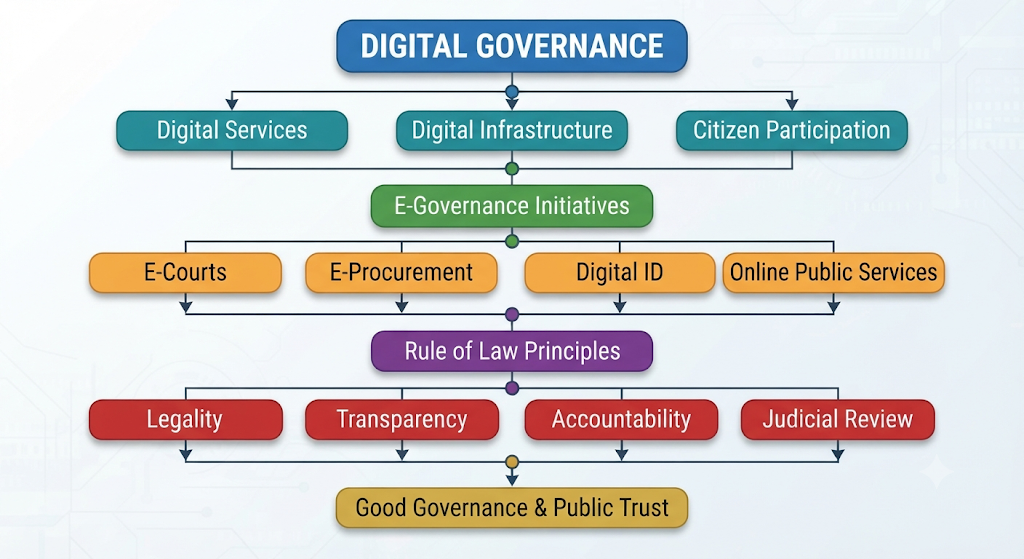
Figure: Conceptual Background
Digital governance became particularly significant during global emergencies such as the COVID-19 pandemic, when governments relied extensively upon digital platforms to provide healthcare services, social welfare benefits, educational resources, judicial proceedings, vaccination management, and public information. These developments demonstrated both the transformative potential and the legal vulnerabilities of digital governance systems.
Furthermore, international organizations increasingly encourage governments to adopt digital governance strategies consistent with principles of transparency, accountability, citizen participation, and sustainable development. Countries have enacted legislation governing data protection, cybersecurity, electronic transactions, digital signatures, artificial intelligence, and digital public infrastructure to establish legal certainty within expanding digital ecosystems. Nevertheless, legal regulation often struggles to keep pace with rapid technological innovation.
Digital governance also raises concerns regarding the digital divide, particularly in developing countries where unequal access to internet connectivity, digital literacy, infrastructure, and technological resources limits citizens' ability to benefit equally from digital public services. Consequently, inclusive digital governance requires not only technological advancement but also legal safeguards that guarantee equality, accessibility, non-discrimination, and effective remedies for violations of digital rights.
This chapter explores the evolving relationship between digital governance and the rule of law by examining legal frameworks governing e-governance initiatives, technological innovations, constitutional principles, digital rights, administrative accountability, and future challenges facing modern democratic states.
Evolution of Digital Governance and Legal Frameworks#
The evolution of digital governance represents one of the most significant transformations in public administration during the twenty-first century. Governments across the world have progressively shifted from traditional paper-based administrative systems to technology-driven governance models that utilize information and communication technologies (ICT), cloud computing, artificial intelligence, blockchain, big data analytics, and digital communication platforms to improve public service delivery. Initially, e-governance focused primarily on digitizing government records and providing basic online services such as tax filing, utility payments, and document registration. Over time, however, digital governance has expanded into a comprehensive framework encompassing digital identities, electronic procurement, online judicial services, digital healthcare, smart city administration, electronic voting support systems, land record management, social welfare distribution, and integrated citizen service portals. This transformation has fundamentally changed the relationship between governments and citizens by making public administration more efficient, transparent, participatory, and responsive. The rapid expansion of internet connectivity and mobile technologies has further accelerated the adoption of digital governance, enabling citizens to access public services regardless of geographical location while reducing bureaucratic delays, administrative costs, and opportunities for corruption. Governments increasingly recognize that digital governance is not merely a technological innovation but a strategic approach to strengthening democratic governance, promoting inclusive development, and improving institutional accountability. The legal foundation of digital governance is rooted in constitutional principles, administrative law, information technology legislation, data protection laws, electronic transaction statutes, cybersecurity regulations, and human rights frameworks. These legal instruments collectively ensure that digital governance operates within the boundaries of legality, transparency, fairness, accountability, and judicial oversight. One of the earliest legal developments supporting digital governance was the enactment of electronic transaction laws recognizing electronic records, digital signatures, and online contracts as legally valid. Such legislation established the legal certainty necessary for governments and citizens to conduct official transactions through electronic platforms. Subsequently, governments introduced comprehensive laws regulating digital identities, online authentication, electronic payments, digital procurement, and public information management. Data protection legislation has emerged as another critical component of digital governance because governments increasingly collect, process, and store large volumes of personal information through digital service platforms. Robust legal frameworks governing personal data processing help safeguard citizens against unauthorized surveillance, identity theft, misuse of personal information, and violations of privacy rights while promoting public confidence in digital governance systems. Cybersecurity legislation likewise plays an essential role in protecting critical government infrastructure from cyberattacks, ransomware, hacking, digital espionage, and other forms of cybercrime capable of disrupting essential public services. Modern legal frameworks increasingly require government institutions to implement cybersecurity standards, incident response mechanisms, encryption technologies, and regular security audits to maintain the integrity and resilience of digital governance systems. Administrative law has also evolved significantly in response to digital governance. Traditional principles of procedural fairness, reasoned decision-making, natural justice, transparency, and accountability now extend to automated administrative systems and algorithmic decision-making processes. Citizens continue to possess the right to challenge administrative decisions regardless of whether those decisions are made by human officials or digital systems. Consequently, legal frameworks increasingly emphasize algorithmic transparency, explainability, non-discrimination, and human oversight in public administration. Artificial intelligence has introduced additional legal complexities as governments adopt AI-powered systems for predictive policing, tax administration, welfare allocation, immigration control, judicial case management, healthcare planning, and regulatory enforcement. While AI enhances efficiency and decision-making accuracy, it also raises concerns regarding algorithmic bias, discrimination, lack of transparency, and diminished procedural fairness. Comparative legal experiences demonstrate the growing importance of regulatory frameworks that ensure AI remains accountable, explainable, and consistent with constitutional rights. International organizations have also contributed significantly to the development of digital governance by promoting global standards concerning digital transformation, cybersecurity, open government data, digital inclusion, and ethical artificial intelligence. International cooperation facilitates the exchange of best practices while encouraging harmonization of legal standards governing cross-border data flows, electronic commerce, digital public infrastructure, and cyber resilience. Despite substantial progress, significant legal challenges remain. Many developing countries continue to experience inadequate digital infrastructure, insufficient legislative frameworks, limited institutional capacity, and unequal access to digital technologies, thereby restricting the effective implementation of digital governance initiatives. The digital divide remains a major obstacle to achieving inclusive governance, particularly among rural populations, economically disadvantaged communities, elderly citizens, and individuals with limited digital literacy. Effective legal frameworks must therefore guarantee equal access to digital public services while protecting vulnerable populations from technological exclusion. Future legal development will require continuous adaptation to emerging technologies such as blockchain governance, quantum computing, autonomous administrative systems, decentralized digital identities, and next-generation cybersecurity threats. Ultimately, the evolution of digital governance demonstrates that technological innovation alone cannot ensure effective governance. Sustainable digital transformation depends upon comprehensive legal frameworks that uphold the rule of law, protect constitutional rights, strengthen public trust, promote transparency, ensure accountability, and facilitate equitable access to government services while enabling innovation in an increasingly digital society.
Legal Challenges of E-Governance: Privacy, Cybersecurity, and Accountability#
The rapid expansion of e-governance has significantly improved the efficiency, accessibility, and transparency of public administration; however, it has also generated a wide range of legal challenges that directly affect the rule of law, constitutional governance, and the protection of fundamental rights. As governments increasingly depend upon digital technologies to deliver essential public services, maintain public records, collect taxes, administer welfare programs, regulate businesses, conduct judicial proceedings, and manage national security, the legal framework governing these digital systems must evolve to address emerging risks associated with privacy, cybersecurity, administrative accountability, algorithmic governance, and digital inclusion. Among these challenges, the protection of privacy and personal data remains one of the most significant legal concerns. E-governance platforms routinely collect extensive personal information, including names, addresses, financial records, health information, biometric identifiers, educational records, employment histories, and digital identities. While such information enables governments to provide efficient and personalized services, it also increases the risk of unauthorized access, identity theft, data breaches, surveillance, and misuse of sensitive personal information. Consequently, governments must establish comprehensive data protection laws that regulate the collection, processing, storage, sharing, and retention of personal data while ensuring informed consent, purpose limitation, transparency, and effective legal remedies for affected individuals. Closely related to privacy is the growing concern regarding government surveillance. Advances in artificial intelligence, facial recognition systems, biometric authentication, geolocation tracking, and predictive analytics have significantly enhanced governmental monitoring capabilities. Although these technologies may strengthen law enforcement, national security, and public administration, excessive surveillance without adequate judicial oversight can undermine constitutional rights to privacy, freedom of expression, association, and personal liberty. The rule of law therefore requires that surveillance activities remain lawful, proportionate, necessary, transparent, and subject to independent judicial review. Cybersecurity constitutes another major legal challenge facing digital governance. Government databases and digital infrastructure increasingly serve as targets for cyberattacks, ransomware incidents, phishing campaigns, hacking, cyber espionage, insider threats, and attacks on critical infrastructure. Successful cyberattacks can disrupt essential public services, compromise national security, expose confidential government records, and erode public trust in digital governance systems. Effective cybersecurity governance requires comprehensive legislation establishing minimum security standards, mandatory risk assessments, encryption protocols, incident reporting mechanisms, cybersecurity audits, institutional responsibilities, and international cooperation against cybercrime. Governments must also develop legal frameworks supporting cyber resilience while balancing cybersecurity measures with constitutional protections for civil liberties. The increasing use of artificial intelligence and algorithmic decision-making in public administration presents additional legal complexities. Governments now employ automated systems to assist in taxation, immigration control, policing, healthcare management, welfare distribution, recruitment, judicial case management, and regulatory enforcement. Although AI systems improve efficiency and consistency, they may also produce biased, discriminatory, or inaccurate outcomes due to flawed data, opaque algorithms, or inadequate oversight. Individuals affected by automated governmental decisions possess a legitimate expectation of procedural fairness, transparency, and the opportunity to challenge administrative actions. Accordingly, legal frameworks must require explainable algorithms, human supervision, accountability mechanisms, regular auditing, and accessible appeal procedures to ensure that automated decision-making complies with constitutional principles of equality, natural justice, and due process. Administrative accountability also becomes increasingly important as digital governance expands. Digital platforms should not reduce governmental responsibility merely because decisions are processed electronically. Public officials remain legally accountable for ensuring that digital systems operate fairly, lawfully, and efficiently. Administrative law therefore continues to require transparency in governmental decision-making, publication of administrative rules, access to information, independent oversight institutions, and judicial review of administrative actions. Citizens must retain the right to challenge digital administrative decisions before competent authorities and courts whenever their rights or legitimate interests are adversely affected. Another important legal concern is digital exclusion, often referred to as the digital divide. Despite rapid technological progress, many individuals continue to face barriers related to internet connectivity, digital literacy, language accessibility, disability, age, economic inequality, and geographic isolation. If governments rely exclusively on digital platforms without providing accessible alternatives, significant portions of the population may be excluded from essential public services, thereby violating constitutional principles of equality, non-discrimination, and access to justice. Legal frameworks governing e-governance should therefore require inclusive digital design, multilingual services, accessibility standards for persons with disabilities, affordable internet access, digital literacy initiatives, and alternative service delivery mechanisms for vulnerable populations. Cross-border data transfers and international digital cooperation introduce further legal challenges. Government data increasingly flows across jurisdictions through cloud computing, international digital platforms, and global technology providers, raising questions concerning jurisdiction, data sovereignty, conflict of laws, and cross-border regulatory enforcement. International legal cooperation and harmonized standards become essential for addressing these complex issues while protecting national interests and individual rights. Furthermore, emerging technologies such as blockchain, quantum computing, digital currencies, smart contracts, and decentralized digital identities will require continual legislative adaptation to maintain legal certainty and administrative efficiency. Ultimately, the success of e-governance depends not merely on technological innovation but on the existence of a comprehensive legal framework that safeguards privacy, strengthens cybersecurity, ensures administrative accountability, protects constitutional rights, guarantees digital inclusion, and maintains public confidence in digital public administration. By integrating robust legal safeguards with responsible technological development, governments can ensure that digital governance strengthens rather than weakens the rule of law, democratic accountability, and citizen trust in public institutions.
Future Prospects and Strengthening the Rule of Law in Digital Governance#
The future of digital governance depends upon the ability of governments to integrate technological innovation with the fundamental principles of the rule of law, democratic accountability, constitutional governance, and human rights protection. As digital transformation accelerates across every sector of public administration, governments will increasingly rely on artificial intelligence, blockchain technology, cloud computing, big data analytics, the Internet of Things (IoT), machine learning, quantum computing, digital identities, and automated administrative systems to improve governance and deliver public services more efficiently. These technologies offer unprecedented opportunities to enhance transparency, reduce administrative costs, improve policy implementation, eliminate corruption, and strengthen citizen participation in governmental decision-making. However, technological advancement alone cannot guarantee good governance unless supported by comprehensive legal frameworks that ensure legality, fairness, accountability, transparency, and judicial oversight. One of the foremost priorities for the future is the development of citizen-centric digital governance, where digital public services are designed around the needs, rights, and expectations of citizens rather than administrative convenience. Governments should adopt legal standards requiring digital services to be accessible, affordable, inclusive, multilingual, and user-friendly while ensuring equal access for rural populations, economically disadvantaged communities, elderly individuals, and persons with disabilities. Bridging the digital divide through investments in digital infrastructure, broadband connectivity, digital literacy programs, and public awareness initiatives will remain essential for ensuring that digital governance contributes to social justice rather than technological inequality. Another important area of future development involves strengthening legal regulation of artificial intelligence in public administration. Governments are expected to expand the use of AI for taxation, judicial administration, healthcare, education, urban planning, immigration management, law enforcement, and public resource allocation. To preserve the rule of law, AI systems must operate within legally enforceable principles of transparency, explainability, accountability, non-discrimination, proportionality, and human oversight. Legislative frameworks should require regular algorithmic audits, independent regulatory supervision, impact assessments, and effective mechanisms through which citizens can challenge automated administrative decisions. Human decision-makers should retain ultimate responsibility for decisions affecting constitutional rights and individual liberties. Data governance will likewise become a central pillar of future digital governance. Governments must establish comprehensive legal frameworks governing personal data protection, data sharing, data security, cross-border data transfers, digital identities, and government databases.
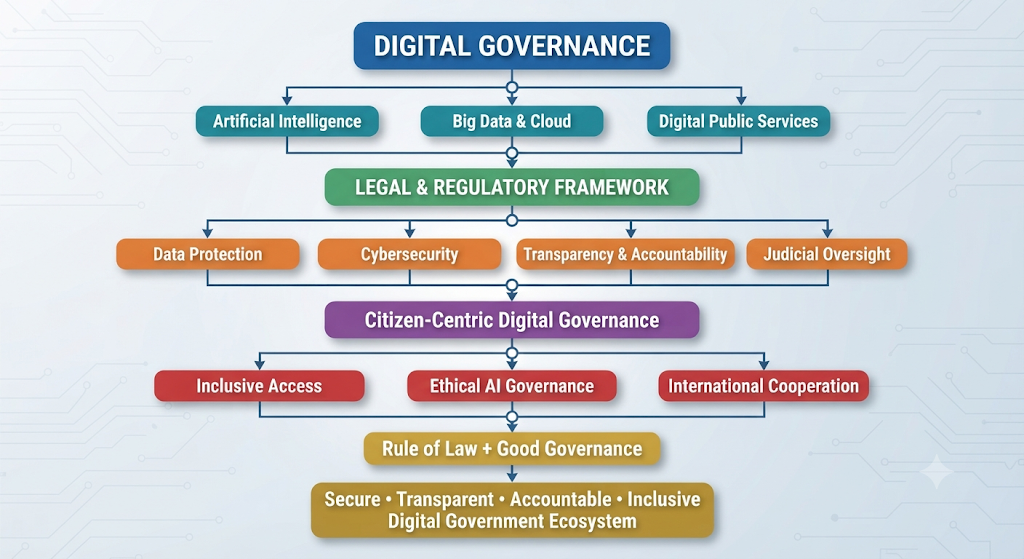
Future: Future Prospects and Strengthening the Rule of Law in Digital Governance
Privacy-by-design principles, informed consent, purpose limitation, data minimization, and strong cybersecurity safeguards should become mandatory components of all digital governance initiatives. Independent data protection authorities, judicial review mechanisms, and parliamentary oversight institutions will play increasingly important roles in ensuring governmental accountability concerning personal data management. Future digital governance will also require stronger cybersecurity governance. As governments digitize critical infrastructure, financial systems, healthcare networks, transportation systems, electoral processes, and public administration, cyber threats will become increasingly sophisticated and disruptive. Comprehensive cybersecurity legislation should establish mandatory security standards, cyber risk assessments, incident reporting obligations, national cyber emergency response mechanisms, and international cooperation against cybercrime. Public-private partnerships between governments, technology companies, academic institutions, and cybersecurity experts will become essential for developing resilient digital ecosystems capable of responding effectively to emerging cyber threats. Judicial institutions themselves will continue undergoing digital transformation through electronic filing systems, virtual court proceedings, digital evidence management, online dispute resolution mechanisms, and AI-assisted legal research. While these innovations enhance access to justice and improve judicial efficiency, courts must continue safeguarding procedural fairness, transparency, judicial independence, confidentiality, and equal access to legal remedies. The future rule of law requires that technological modernization strengthens rather than compromises judicial integrity and constitutional accountability. International cooperation will become increasingly important because digital governance transcends national boundaries. Cybercrime, digital trade, cross-border data flows, online financial transactions, artificial intelligence governance, digital taxation, and international cybersecurity require harmonized legal standards and collaborative regulatory mechanisms. Governments should actively participate in international efforts to develop common principles governing ethical AI, digital human rights, cybersecurity norms, electronic commerce, and digital public infrastructure while respecting constitutional sovereignty and national legal traditions. Environmental sustainability will also influence future digital governance. Governments should promote energy-efficient digital infrastructure, environmentally sustainable data centers, responsible electronic waste management, and green information technologies that contribute to sustainable development objectives. Ethical governance will emerge as another defining feature of future digital transformation. Public institutions must ensure that digital technologies operate in accordance with constitutional values including equality, human dignity, non-discrimination, transparency, accountability, and respect for human rights. Independent ethics committees, regulatory authorities, parliamentary oversight, civil society participation, and public consultation should become integral components of digital policymaking. Ultimately, strengthening the rule of law in digital governance requires more than adopting advanced technologies; it demands robust legal institutions, comprehensive regulatory frameworks, effective judicial oversight, responsible innovation, public participation, and unwavering commitment to constitutional principles. By integrating technological progress with legality, transparency, accountability, privacy protection, cybersecurity, and democratic governance, governments can establish resilient digital governance systems that enhance public trust, promote inclusive development, protect fundamental rights, and ensure that technological transformation remains firmly grounded in the rule of law.
Conclusion#
Digital governance has fundamentally transformed the manner in which governments interact with citizens, deliver public services, formulate public policies, and administer democratic institutions in the twenty-first century. The integration of information and communication technologies into governance has created unprecedented opportunities for improving administrative efficiency, transparency, accountability, public participation, and access to government services. E-governance initiatives, including digital identity systems, electronic procurement, online taxation, digital healthcare, e-courts, electronic land records, online grievance redressal mechanisms, and integrated public service portals, have significantly reduced bureaucratic delays, enhanced institutional responsiveness, and strengthened citizen engagement. As demonstrated throughout this chapter, digital governance is not merely a technological innovation but a comprehensive transformation of public administration that requires a strong legal foundation based on constitutional principles and the rule of law. The rule of law remains the cornerstone of democratic governance because it ensures that every governmental action, whether conducted through traditional institutions or digital platforms, is authorized by law, transparent, accountable, non-discriminatory, and subject to independent judicial review. Consequently, the successful implementation of e-governance depends not only on technological advancement but also on comprehensive legal and regulatory frameworks capable of protecting constitutional rights while promoting innovation. The study has highlighted the evolution of digital governance from simple electronic service delivery to sophisticated digital ecosystems supported by artificial intelligence, cloud computing, blockchain technology, big data analytics, machine learning, and integrated digital public infrastructure. These technologies have substantially improved governmental capacity to deliver efficient and accessible public services; however, they have simultaneously introduced complex legal challenges concerning privacy, cybersecurity, data protection, algorithmic accountability, administrative fairness, digital surveillance, and cross-border data governance. The increasing use of automated decision-making systems within public administration further emphasizes the necessity of maintaining transparency, explainability, procedural fairness, and effective human oversight to ensure that technological efficiency does not undermine constitutional guarantees of equality, justice, and due process. Similarly, the chapter has demonstrated that cybersecurity has become an essential component of modern governance because attacks on digital government infrastructure can threaten national security, public confidence, economic stability, and the continuity of essential public services. Comprehensive cybersecurity legislation, institutional preparedness, international cooperation, and continuous technological adaptation are therefore indispensable for protecting digital governance systems from evolving cyber threats. Another significant finding concerns the importance of protecting personal data and digital privacy within expanding e-governance frameworks. Citizens increasingly entrust governments with extensive personal information through digital platforms, making robust data protection laws, independent regulatory authorities, judicial oversight, and transparent administrative practices essential for maintaining public trust. At the same time, governments must ensure that digital governance remains inclusive by addressing the persistent digital divide affecting rural communities, economically disadvantaged populations, elderly citizens, persons with disabilities, and individuals lacking digital literacy. Equal access to digital public services represents not only an administrative objective but also a constitutional obligation derived from principles of equality, social justice, and non-discrimination. Looking toward the future, digital governance will continue evolving alongside emerging technologies such as quantum computing, advanced artificial intelligence, decentralized digital identities, blockchain-based public administration, smart cities, autonomous governmental systems, and digital public infrastructure. These developments will create new opportunities for improving governance while simultaneously generating novel legal questions requiring adaptive legislation, interdisciplinary research, and international collaboration. Governments must therefore adopt proactive legal strategies capable of responding effectively to rapidly changing technological environments without compromising democratic accountability or constitutional values. Strengthening the rule of law within digital governance will require continuous legislative reform, independent judicial institutions, transparent administrative procedures, ethical standards for artificial intelligence, effective cybersecurity governance, public participation, and international cooperation in addressing transnational digital challenges. Ultimately, the relationship between digital governance and the rule of law should be viewed as complementary rather than conflicting. Technology should function as an instrument for strengthening constitutional governance, expanding access to justice, improving administrative accountability, promoting transparency, protecting fundamental rights, and enhancing public trust in democratic institutions. When supported by comprehensive legal frameworks, responsible innovation, independent oversight mechanisms, and citizen-centered governance, digital transformation has the potential to create more efficient, transparent, inclusive, and resilient public institutions capable of meeting the evolving needs of modern society. Therefore, achieving sustainable digital governance requires a balanced approach that combines technological excellence with constitutional principles, ensuring that innovation remains firmly anchored in legality, justice, equality, accountability, and respect for human dignity. Through such an approach, digital governance can become a powerful catalyst for strengthening democratic governance, promoting sustainable development, and advancing the rule of law in the digital age.
Works Cited#
- Bertot, J. C., Jaeger, P. T., & Grimes, J. M. (2010). Using ICTs to create a culture of transparency: E-government and social media as openness and anti-corruption tools for societies. Government Information Quarterly, 27(3), 264–271.
- Brown, I. (Ed.). (2013). Research Handbook on Governance of the Internet. Edward Elgar Publishing.
- Dawes, S. S. (2008). The evolution and continuing challenges of e-governance. Public Administration Review, 68(S1), S86–S102.
- Dunleavy, P., Margetts, H., Bastow, S., & Tinkler, J. (2006). Digital Era Governance: IT Corporations, the State, and E-Government. Oxford University Press.
- Fountain, J. E. (2001). Building the Virtual State: Information Technology and Institutional Change. Brookings Institution Press.
- Gil-Garcia, J. R., Pardo, T. A., & Nam, T. (Eds.). (2016). Smarter as the New Urban Agenda. Springer.
- Heeks, R. (2006). Implementing and Managing E-Government: An International Text. SAGE Publications.
- Janssen, M., Charalabidis, Y., & Zuiderwijk, A. (2012). Benefits, adoption barriers and myths of open data and open government. Information Systems Management, 29(4), 258–268.
- Margetts, H., & Dunleavy, P. (2013). The Second Wave of Digital-Era Governance. Oxford Internet Institute.
- OECD. (2020). Digital Government Index: 2019 Results. OECD Publishing.
- OECD. (2023). Digital Government Policy Framework. OECD Publishing.
- Scholl, H. J. (2005). E-government-induced business process change. Government Information Quarterly, 22(3), 458–480.
- United Nations. (2022). United Nations E-Government Survey 2022: The Future of Digital Government. United Nations.
- United Nations Development Programme. (2021). Digital Strategy 2022–2025. UNDP.
- West, D. M. (2005). Digital Government: Technology and Public Sector Performance. Princeton University Press.
- World Bank. (2021). GovTech Maturity Index: The State of Public Sector Digital Transformation. World Bank.
- World Economic Forum. (2023). Global Cybersecurity Outlook 2023. World Economic Forum.
- Zuboff, S. (2019). The Age of Surveillance Capitalism. PublicAffairs.
- Bannister, F., & Connolly, R. (2014). ICT, public values, and transformative government. Government Information Quarterly, 31(1), 119–128.
- Cordella, A., & Tempini, N. (2015). E-government and organizational change. Government Information Quarterly, 32(3), 279–282.